Why Gaze Following Matters: What Reptile Vision Reveals About Cognition
Gaze following reveals reptile cognition—how vision, attention, and social cues shape perception, learning, and welfare insights in reptile behavior.
Van Halsey
Lead Researcher- Herpetological Environments and Research in Practice (HERP) Laboratory, Eckerd College
- Gaze following is the ability to look where another individual is looking, a simple behavior that reveals how animals perceive, communicate, and even cooperate.
- In birds and mammals, gaze following encompasses complex forms, such as geometric gaze following.
- Research on tortoises and geckos shows that reptiles can follow gazes, demonstrating true social attention rather than simple reflexes.
- By studying gaze following and lateralization in crested geckos, we can uncover how attention and cognition evolve to design welfare-focused captive environments.
Gaze following is the ability to look where another individual is looking, a simple behavior that reveals how animals perceive, communicate, and even cooperate.
What if you could see what an animal is thinking, just by watching where it looks? In the animal kingdom, a simple behavior called gaze following can tell us a lot about how different species perceive the world, communicate, and even cooperate.[13]Zeiträg, C., Jensen, T. R., & Osvath, M. (2022). Gaze following: A socio-cognitive skill rooted in deep time. Frontiers in psychology, 13, 950935. https://doi.org/10.3389/fpsyg.2022.950935View source Now, thanks to research on reptiles, we’re beginning to see that this behavior may be much older and more widespread than we previously thought. Gaze following is the ability to shift your attention in the same direction that someone else is looking.[13]Zeiträg, C., Jensen, T. R., & Osvath, M. (2022). Gaze following: A socio-cognitive skill rooted in deep time. Frontiers in psychology, 13, 950935. https://doi.org/10.3389/fpsyg.2022.950935View source It might sound basic, but it's a foundation of social cognition—the set of mental abilities animals use to understand and respond to other individuals. Animal cognition can be defined as “the mechanisms by which animals acquire, process, store, and act on environmental information”.[9]Shettleworth, S. J. (2010). Cognition, evolution, and behavior (2nd ed.). Oxford University Press. https://psycnet.apa.org/record/2009-24069-000View source
Animals that follow gaze can anticipate danger, locate food, and coordinate behavior within a group.[13]Zeiträg, C., Jensen, T. R., & Osvath, M. (2022). Gaze following: A socio-cognitive skill rooted in deep time. Frontiers in psychology, 13, 950935. https://doi.org/10.3389/fpsyg.2022.950935View source This includes things like recognizing social partners, learning from others, and predicting behavior. In short, it’s what allows animals to interpret attention, intention, and interaction. In humans, gaze following begins in infancy and lays the groundwork for theory of mind—our ability to understand that others have their own perspectives, beliefs, and goals.[13]Zeiträg, C., Jensen, T. R., & Osvath, M. (2022). Gaze following: A socio-cognitive skill rooted in deep time. Frontiers in psychology, 13, 950935. https://doi.org/10.3389/fpsyg.2022.950935View source But gaze following isn’t just about sociality. Mammals, birds, and reptiles all diverged from a common amniote ancestor over 300 million years ago.[13]Zeiträg, C., Jensen, T. R., & Osvath, M. (2022). Gaze following: A socio-cognitive skill rooted in deep time. Frontiers in psychology, 13, 950935. https://doi.org/10.3389/fpsyg.2022.950935View source If gaze following is present in all three lineages, it may either have very deep evolutionary roots or may have evolved multiple times under different pressures. It also tells us something about how intelligence evolved. If we know which species can do it and in what contexts, we can begin to piece together how the social brain evolved.[13]Zeiträg, C., Jensen, T. R., & Osvath, M. (2022). Gaze following: A socio-cognitive skill rooted in deep time. Frontiers in psychology, 13, 950935. https://doi.org/10.3389/fpsyg.2022.950935View source If reptiles—animals we don’t usually think of as social—can follow gaze, it could change the way we care for them in captivity. Gaze sensitivity might be a sign that they respond to more than just their physical environment. They may be paying attention to each other—and to us.
In birds and mammals, gaze following ranges from simply looking in the same direction to more complex forms like geometric gaze following.
Gaze following is well-documented in birds and mammals, particularly in social species. Ravens, for example, begin following gaze in their first months of life and learn to follow gaze around obstacles as they mature—strong evidence of perspective-taking, or the ability to recognize that another being might see something you do not.[2]Bugnyar, T., Stöwe, M., & Heinrich, B. (2004, July 7). Ravens, Corvus corax, follow gaze direction of humans around obstacles. Proceedings of the Royal Society B. https://royalsocietypublishing.org/doi/10.1098/rspb.2004.2738View source Ibises, on the other hand, can follow gaze into open space but not around barriers, hinting at different levels of cognitive complexity.[4]Loretto, M. C., Schloegl, C., & Bugnyar, T. (2009). Northern bald ibises follow others’ gaze into distant space but not behind barriers. Biology Letters, 6(1), 14-17. https://royalsocietypublishing.org/doi/10.1098/rsbl.2009.0510View source This matters because it suggests that different cognitive mechanisms may be behind simple co-orientation and more complex forms, such as geometric gaze following.[4]Loretto, M. C., Schloegl, C., & Bugnyar, T. (2009). Northern bald ibises follow others’ gaze into distant space but not behind barriers. Biology Letters, 6(1), 14-17. https://royalsocietypublishing.org/doi/10.1098/rsbl.2009.0510View source That means—not just looking in the same direction—but repositioning themselves to see something hidden behind a barrier. Not all species show both types of gaze following abilities. Chimpanzees and dogs can follow a gaze geometrically.[4]Loretto, M. C., Schloegl, C., & Bugnyar, T. (2009). Northern bald ibises follow others’ gaze into distant space but not behind barriers. Biology Letters, 6(1), 14-17. https://royalsocietypublishing.org/doi/10.1098/rsbl.2009.0510View source [5]Met, A., Miklósi, Á. & Lakatos, G. Gaze-following behind barriers in domestic dogs. Anim Cogn 17, 1401–1405 (2014). https://doi.org/10.1007/s10071-014-0754-zView sourceMonkeys, like spider and capuchins, do too, though they may lack the ability to mentally "check back" when the information doesn’t line up, showing a more limited form of perspective-taking.[1]Amici, F., Aureli, F., Visalberghi, E., & Call, J. (2009). Spider monkeys (Ateles geoffroyi) and capuchin monkeys (Cebus apella) follow gaze around barriers: Evidence for perspective taking? Journal of Comparative Psychology, 123(4), 368–374. https://doi.org/10.1037/a0017079View source So what does this mean for reptiles?
Research on tortoises and geckos shows that reptiles can follow gaze—including geometric gaze following—demonstrating true social attention rather than simple reflexes.
In 2010, researcher Anna Wilkinson and colleagues published a study showcasing red-footed tortoises.[12]Wilkinson, A., Mandl, I., Bugnyar, T. et al. Gaze following in the red-footed tortoise (Geochelone carbonaria). Anim Cogn 13, 765–769 (2010). https://doi.org/10.1007/s10071-010-0320-2View source Despite being solitary animals, they would look up when they saw another tortoise doing so. But they didn’t react when there was just a flashing light or no demonstrators at all. Tortoises only followed the gaze when another tortoise did, not in the control conditions. This demonstrated true social gaze following, not just reflexive orientation to movement or light.[12]Wilkinson, A., Mandl, I., Bugnyar, T. et al. Gaze following in the red-footed tortoise (Geochelone carbonaria). Anim Cogn 13, 765–769 (2010). https://doi.org/10.1007/s10071-010-0320-2View source
It also opened a new question: can reptiles perform geometric gaze following? In 2022, researcher Joe Simpson investigated whether leopard geckos—a species considered both asocial and nocturnal—could perform a more complex form of gaze following: geometric gaze following, where an animal must follow another’s gaze around a barrier to a hidden location.[8]Simpson, J., O’Hara, S.J. Gaze following in an asocial reptile (Eublepharis macularius). Anim Cogn 22, 145–152 (2019). https://doi.org/10.1007/s10071-018-1230-yView source The geckos were significantly more likely to respond by looking toward or attempting to investigate the occluded area when the demonstrator gecko looked up at the stimulus. This suggests that the geckos weren’t simply reacting to movement, light, or the presence of another animal, but were actively using social gaze cues to direct their attention to a hidden point of interest.[8]Simpson, J., O’Hara, S.J. Gaze following in an asocial reptile (Eublepharis macularius). Anim Cogn 22, 145–152 (2019). https://doi.org/10.1007/s10071-018-1230-yView source
In a broader context, this supports the growing field of comparative social cognition, which seeks to understand how cognitive behaviors, such as gaze following, are distributed across different species and evolutionary histories. It also challenges the assumption that these behaviors evolved only for social cooperation, instead pointing toward more general cognitive mechanisms that may benefit a wide range of animals.
By studying gaze following and lateralization in crested geckos, we can uncover how attention and cognition evolve to design welfare-focused captive environments.
At our lab, we’re currently testing Crested Geckos (Correlophus ciliatus) to see whether they, too, can follow a gaze and how this behavior develops with age. Why crested geckos? Because they’re arboreal (tree-dwelling), nocturnal, and largely asocial, if they show gaze following behavior, it would further support the idea that this ability does not require strong social bonds. It might instead be shaped by ecological pressures, such as foraging efficiency, evading predators, or navigating complex environments. There’s something more subtle we’re looking at: lateralisation. When animals show a preference for using one eye over the other, it can hint at what kind of emotional or cognitive state they’re in.[6]Rogers, L. J. (1989). Laterality in Animals. https://escholarship.org/content/qt9h15z1vr/qt9h15z1vr.pdfView source [7]Rogers, L. J. (2010, January 1). Relevance of brain and behavioural lateralization to Animal Welfare. Applied Animal Behaviour Science. https://www.academia.edu/48010412/Relevance_of_brain_and_behavioural_lateralization_to_animal_welfareView sourceIf that’s true, it means gaze following could be a general cognitive skill, not a special feature of "social" brains—but one deeply tied to attention, emotion, and survival.
Understanding gaze following tells us how animals think, what they care about, and what we do that may affect them. For reptiles—an often overlooked group—it may help us build richer, more responsive environments in captivity. Ones that reflect more than what animals need to survive, but what they need to engage with the world around them.
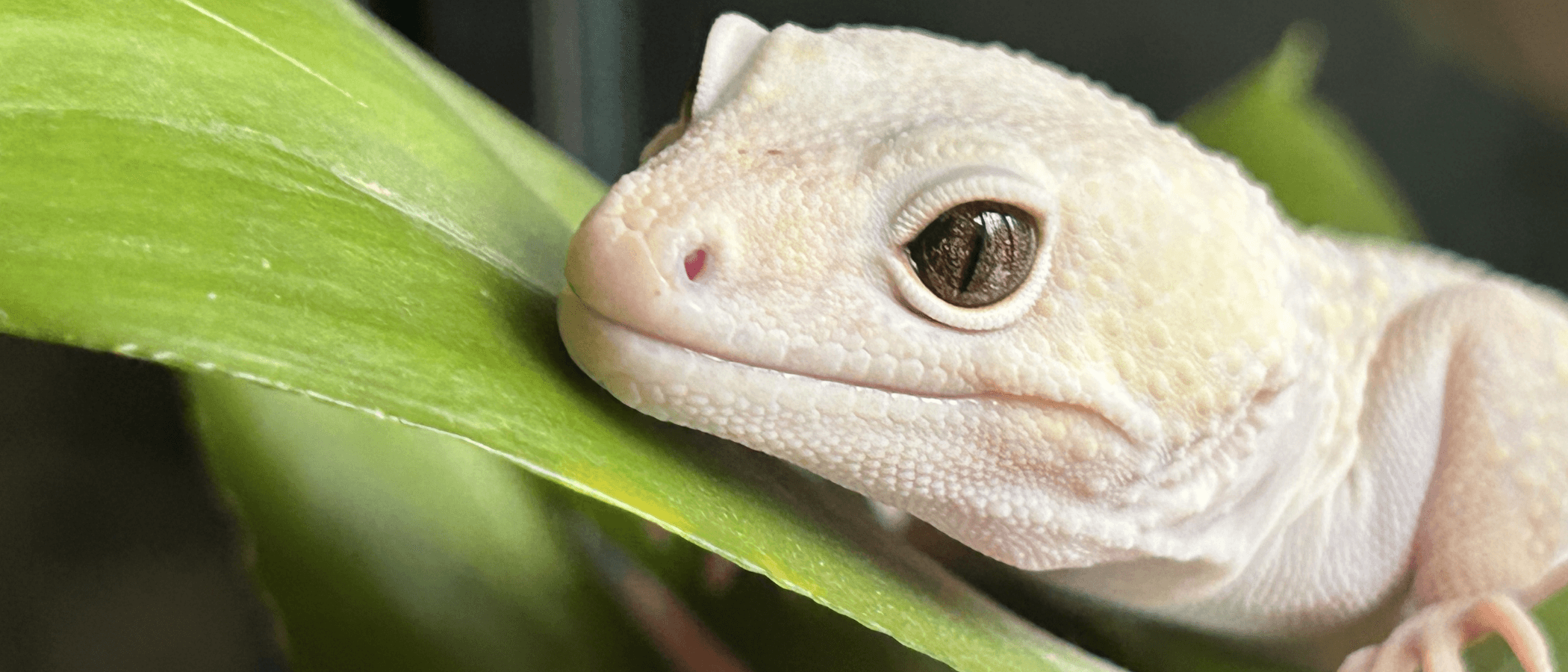
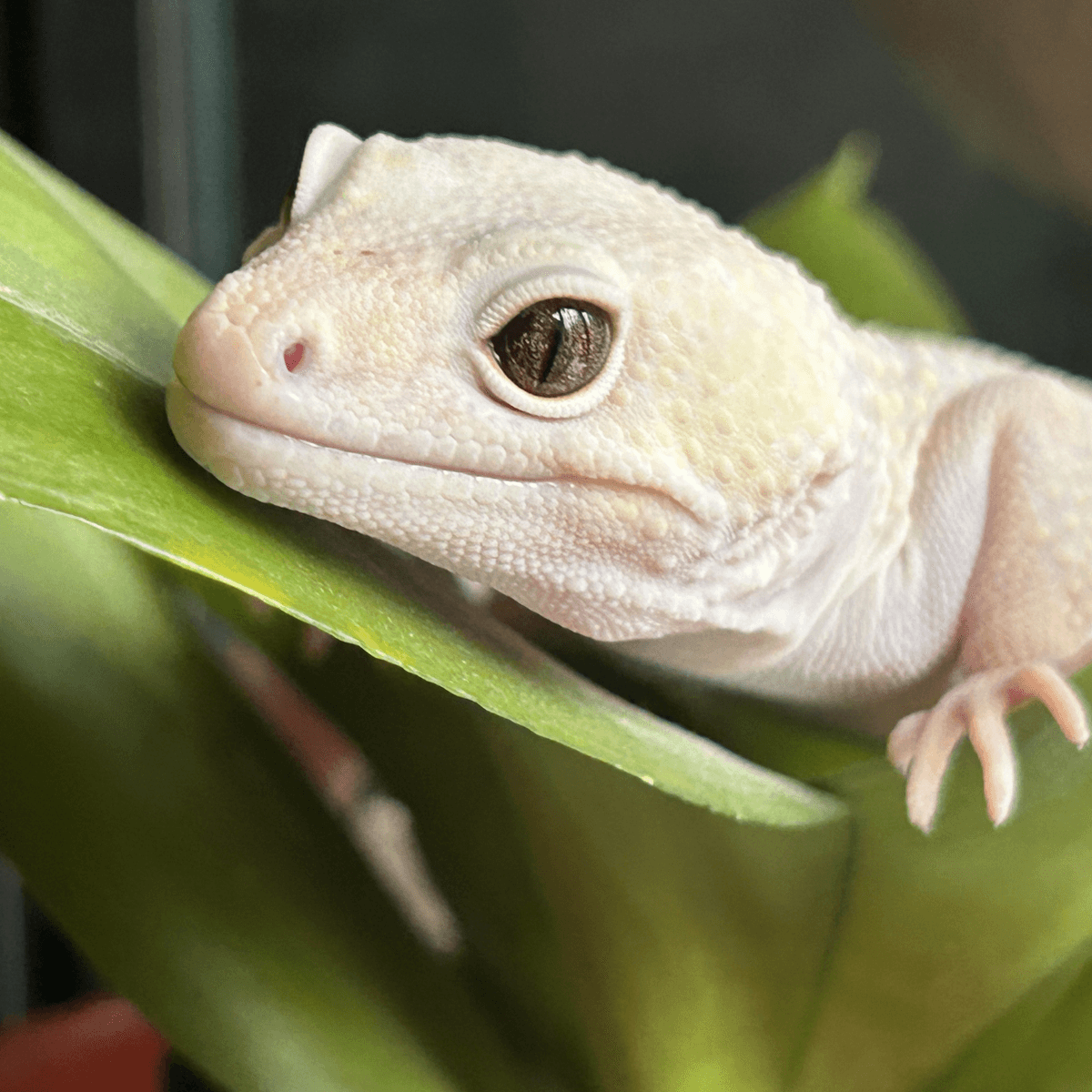
Image Credit: Leopard gecko on a leaf. HERP Lab, 2023.[3]Eckerd College HERP lab, June 26, 2023. Leopard gecko on a leaf.
References
- [1]Amici, F., Aureli, F., Visalberghi, E., & Call, J. (2009). Spider monkeys (Ateles geoffroyi) and capuchin monkeys (Cebus apella) follow gaze around barriers: Evidence for perspective taking? Journal of Comparative Psychology, 123(4), 368–374. https://doi.org/10.1037/a0017079
- [2]Bugnyar, T., Stöwe, M., & Heinrich, B. (2004, July 7). Ravens, Corvus corax, follow gaze direction of humans around obstacles. Proceedings of the Royal Society B. https://royalsocietypublishing.org/doi/10.1098/rspb.2004.2738
- [3]Eckerd College HERP lab, June 26, 2023. Leopard gecko on a leaf.
- [4]Loretto, M. C., Schloegl, C., & Bugnyar, T. (2009). Northern bald ibises follow others’ gaze into distant space but not behind barriers. Biology Letters, 6(1), 14-17. https://royalsocietypublishing.org/doi/10.1098/rsbl.2009.0510
- [5]Met, A., Miklósi, Á. & Lakatos, G. Gaze-following behind barriers in domestic dogs. Anim Cogn 17, 1401–1405 (2014). https://doi.org/10.1007/s10071-014-0754-z
- [6]Rogers, L. J. (1989). Laterality in Animals. https://escholarship.org/content/qt9h15z1vr/qt9h15z1vr.pdf
- [7]Rogers, L. J. (2010, January 1). Relevance of brain and behavioural lateralization to Animal Welfare. Applied Animal Behaviour Science. https://www.academia.edu/48010412/Relevance_of_brain_and_behavioural_lateralization_to_animal_welfare
- [8]Simpson, J., O’Hara, S.J. Gaze following in an asocial reptile (Eublepharis macularius). Anim Cogn 22, 145–152 (2019). https://doi.org/10.1007/s10071-018-1230-y
- [9]Shettleworth, S. J. (2010). Cognition, evolution, and behavior (2nd ed.). Oxford University Press. https://psycnet.apa.org/record/2009-24069-000
- [10]Shepherd S. V. (2010). Following gaze: gaze-following behavior as a window into social cognition. Frontiers in integrative neuroscience, 4, 5. https://doi.org/10.3389/fnint.2010.00005
- [11]Tomasello, M., Hare, B., & Agnetta, B. (2002, May 25). Chimpanzees, Pan troglodytes, follow gaze direction geometrically. Animal Behaviour. https://www.sciencedirect.com/science/article/abs/pii/S0003347299911922?via%3Dihub
- [12]Wilkinson, A., Mandl, I., Bugnyar, T. et al. Gaze following in the red-footed tortoise (Geochelone carbonaria). Anim Cogn 13, 765–769 (2010). https://doi.org/10.1007/s10071-010-0320-2
- [13]Zeiträg, C., Jensen, T. R., & Osvath, M. (2022). Gaze following: A socio-cognitive skill rooted in deep time. Frontiers in psychology, 13, 950935. https://doi.org/10.3389/fpsyg.2022.950935
