Beyond the Bite and Bridging the Gap: Deciphering the Complex Communication of Crocodiles and Alligators
Explore misconceptions about these animals, discuss communication styles and important findings in new research.
Galen McKenna
Educational Assistant - Herpetological Environments and Research in Practice (HERP) Laboratory, Eckerd College
- Alligators and crocodiles use sound, scent, posture, and vibration to communicate.
- Mating displays include bellowing, head-slapping, and even water “dancing,” which is caused by low-frequency body vibrations.
- Mother crocodiles respond to hatchling calls, showing surprising levels of care and coordination.
- Chemical cues help them find food and mates, especially in murky or low-visibility habitats.
- Some species use infrasound (vibrations too low for humans to hear) to send messages through water.
Crocodiles and alligators may appear similar, but there are key differences in their evolutionary histories.
“What are crocodiles and alligators?” some might ask. To answer that question, they belong to the order of crocodilia, a group encompassing both those animals, as well as caimans, and another you might not have ever heard of before, called the gharial. There are about 14 different identified species of crocodiles in the world, and only 2 of alligators.[12]Hoser, R. T. (2012). A review of the taxonomy of the living Crocodiles including the description of three new tribes, a new genus, and two new species. Australasian Journal of Herpetology, 14, 9-16. https://www.researchgate.net/publication/325544824_A_review_of_the_taxonomy_of_the_living_Crocodiles_including_the_description_of_three_new_tribes_a_new_genus_and_two_new_speciesAustralasian_Journal_of_Herpetology_A_review_of_the_taxonomy_of_the_livinView source The American alligator and the American crocodile are the two native species in America. Over time, the American alligator has undergone minimal evolutionary changes, with the modern species having existed for approximately 8 million years.[25]Whiting, E. T., & Hastings, A. K. (2015). First fossil Alligator from the late Eocene of Nebraska and the Late Paleogene record of alligators in the Great Plains. Journal of Herpetology, 49(4), 560-569 https://doi.org/10.1670/14-069View source This speaks to the adaptability of these animals, as they can overcome many ecological and environmental changes. For instance, in Florida, many gators have begun to take over swimming pools and golf courses in response to urbanization.[19]Rosenblatt, A. E., Greco, R., Beal, E., Colbert, J., Moore, Y., Baglin, V., & Nifong, J. C. (2023). Golf course living leads to a diet shift for American alligators. Ecology and evolution, 13(9), e10495. https://doi.org/10.1002/ece3.10495?urlappend=%3Futm_source%3Dresearchgate.net%26utm_medium%3DarticleView source [12]Hoser, R. T. (2012). A review of the taxonomy of the living Crocodiles including the description of three new tribes, a new genus, and two new species. Australasian Journal of Herpetology, 14, 9-16. https://www.researchgate.net/publication/325544824_A_review_of_the_taxonomy_of_the_living_Crocodiles_including_the_description_of_three_new_tribes_a_new_genus_and_two_new_speciesAustralasian_Journal_of_Herpetology_A_review_of_the_taxonomy_of_the_livinView source
Meanwhile, the crocodile has a bit more complex evolutionary history. According to,[16]Payne, A. R., Mannion, P. D., Lloyd, G. T., & Davis, K. E. (2024). Decoupling speciation and extinction reveals both abiotic and biotic drivers shaped 250 million years of diversity in crocodile-line archosaurs. Nature Ecology & Evolution, 8(1), 121-132. https://doi.org/10.1038/s41559-023-02244-0?urlappend=%3Futm_source%3Dresearchgate.net%26utm_medium%3DarticleView source ancient ancestors of the modern American crocodile likely originated in Europe around 145 million years ago. Due to their ability to tolerate saltwater, these animals spread into different environments, ultimately reaching the Americas, where the modern version of the species evolved. Interestingly, Groh expects that ancient versions were much more active and grew much quicker than the crocs we have here in Florida today.[9]Groh, S. S., Upchurch, P., Day, J. J., & Barrett, P. M. (2023). The biogeographic history of neosuchian crocodiles and the impact of saltwater tolerance variability. Royal Society Open Science, 10(10). https://doi.org/10.1098/rsos.230725View source This is likely due to a shift towards becoming more aquatic creatures, relying on lurking and ambush predation strategies, and living in environments where food is more scarce.
Misconceptions regarding crocodiles and alligators have caused us to overlook their cognitive capabilities.
Our experiences with education surrounding these animals and their representation in popular culture have led to unfortunate misconceptions. For one thing, many attribute the slow or unchanging nature of reptiles to a lack of complexity or social behavior.[3]Boucher, M., Tellez, M., & Anderson, J. (2021). Activity budget and behavioral patterns of American crocodiles (Crocodylus acutus) in Belize. Herpetological Conservation and Biology, 16, 86–94. https://www.researchgate.net/publication/356536288_Activity_Budget_and_Behavioral_Patterns_of_American_crocodiles_Crocodylus_acutus_in_BelizeView source Furthermore, in many forms of media, these animals are represented as the classic “cold-blooded killer” that moves in silence.[7]Fuchs, M. (2015). ‘They are a fact of life out here’: The Ecocritical Subtexts of Three Early-Twenty-First-Century Aussie Animal Horror Movies. In Animal Horror Cinema: Genre, History and Criticism (pp. 37-57). London: Palgrave Macmillan UK. https://doi.org/10.1057/9781137496393_3View source In reality, these animals have complex systems of vocalizations, posturing, chemical cues, and other forms of communication, all relating to individual characteristics and social/environmental contexts.[8]Garrick, L. D., & Lang, J. W. (1977). Social signals and behaviors of adult alligators and crocodiles. American Zoologist, 17(1), 225–239. https://doi.org/10.1093/icb/17.1.225View source
Crocodiles and alligators have a much wider and more complex range of communication than we once thought.
American alligators and crocodiles use a variety of sophisticated social signals, with notable differences between the species, especially during reproduction. For American alligators, courtship involves a repertoire of displays by both sexes, including head slapping, bellowing, and postural shifts.[8]Garrick, L. D., & Lang, J. W. (1977). Social signals and behaviors of adult alligators and crocodiles. American Zoologist, 17(1), 225–239. https://doi.org/10.1093/icb/17.1.225View source The sound of head slaps can attract mates from up to 70 meters away, while bellowing is typically reserved for close proximity.[2]Baker, C. J., Class, B., Dwyer, R. G., Franklin, C. E., Campbell, H. A., Irwin, T. R., & Frère, C. H. (2024). Active crocodiles are less sociable. Philosophical Transactions of the Royal Society B Biological Sciences, 379(1912). https://doi.org/10.1098/rstb.2022.0528View source
In contrast, American crocodiles often use jaw clapping during mating season to defend their territory from other males.[22]Vergne, A. L., Pritz, M. B., & Mathevon, N. (2009). Acoustic communication in crocodilians: from behaviour to brain. Biological Reviews, 84(3), 391-411. https://doi.org/10.1111/j.1469-185X.2009.00079View source Crocodiles also utilize unique signals like roars, which function similarly to alligator head slaps, and subaudial vibrations radiating from their bodies, which can predict further courtship.[1]Augustine, L., Pryes, K., & Evans, M., (2017). Social behavior in captive Cuban crocodiles (Crocodylus rhombifer) at the Smithsonian’s National Zoological Park. Herpetol Rev, 48(1), 75-82 https://www.researchgate.net/publication/315652650_Social_behavior_in_captive_Cuban_crocodiles_Crocodylus_rhombifer_at_the_Smithsonian's_National_Zoological_ParkView source In both species, courtship can be initiated by lifting the snout high and arching the tail out of the water.[15]Kofron, C. P. (1991). Courtship and mating of the Nile crocodile (Crocodylus niloticus). Amphibia-Reptilia, 12(1), 39-48. https://doi.org/10.1111/j.1469-7998.1990.tb04014.x?urlappend=%3Futm_source%3Dresearchgate.net%26utm_medium%3DarticleView source During initial contact, alligators produce soft, cough-like vocalizations to signal non-aggressive intent.[1]Augustine, L., Pryes, K., & Evans, M., (2017). Social behavior in captive Cuban crocodiles (Crocodylus rhombifer) at the Smithsonian’s National Zoological Park. Herpetol Rev, 48(1), 75-82 https://www.researchgate.net/publication/315652650_Social_behavior_in_captive_Cuban_crocodiles_Crocodylus_rhombifer_at_the_Smithsonian's_National_Zoological_ParkView source
Communication is crucial during nesting and the early life stages of these reptiles, facilitating maternal care and group cohesion.[22]Vergne, A. L., Pritz, M. B., & Mathevon, N. (2009). Acoustic communication in crocodilians: from behaviour to brain. Biological Reviews, 84(3), 391-411. https://doi.org/10.1111/j.1469-185X.2009.00079View source When defending a nest against intruders, both female alligators and crocodiles will hiss, with crocodiles also performing jaw claps.[8]Garrick, L. D., & Lang, J. W. (1977). Social signals and behaviors of adult alligators and crocodiles. American Zoologist, 17(1), 225–239. https://doi.org/10.1093/icb/17.1.225View source Both species will also adopt a distinctive posture in the water, with the head arched and tail raised.[22]Vergne, A. L., Pritz, M. B., & Mathevon, N. (2009). Acoustic communication in crocodilians: from behaviour to brain. Biological Reviews, 84(3), 391-411. https://doi.org/10.1111/j.1469-185X.2009.00079View source [1]Augustine, L., Pryes, K., & Evans, M., (2017). Social behavior in captive Cuban crocodiles (Crocodylus rhombifer) at the Smithsonian’s National Zoological Park. Herpetol Rev, 48(1), 75-82 https://www.researchgate.net/publication/315652650_Social_behavior_in_captive_Cuban_crocodiles_Crocodylus_rhombifer_at_the_Smithsonian's_National_Zoological_ParkView source [15]Kofron, C. P. (1991). Courtship and mating of the Nile crocodile (Crocodylus niloticus). Amphibia-Reptilia, 12(1), 39-48. https://doi.org/10.1111/j.1469-7998.1990.tb04014.x?urlappend=%3Futm_source%3Dresearchgate.net%26utm_medium%3DarticleView source
The most fascinating communication occurs during hatching. Hatchlings collectively bark with "eeau" sounds from inside their eggs, often in response to vibrations.[6]Delbosc, N. C., Boyer, N., Mathevon, N., & Grimault, N. (2025). Crocodile mothers’ response to hatching calls. Animal Behaviour, 220, 123040. https://dio.org/10.1016/j.anbehav.2024.11.018View source This group-minded call prompts the female to excavate them from the nest.[23]Vergne, A. L., Avril, A., Martin, S., & Mathevon, N. (2007). Parent–offspring communication in the Nile crocodile Crocodylus niloticus: do newborns’ calls show an individual signature?. Naturwissenschaften, 94(1), 49-54. https://doi.org/10.1007/s00114-006-0156-4View source Post-hatching, young rely on loud, repetitive distress calls to signal to the mother when they are in danger, with adults reliably locating the source of these calls.[8]Garrick, L. D., & Lang, J. W. (1977). Social signals and behaviors of adult alligators and crocodiles. American Zoologist, 17(1), 225–239. https://doi.org/10.1093/icb/17.1.225View source
Communication for these aquatic reptiles is more than just sound; chemoreception aids in sending and receiving signals.
Beyond acoustic and visual displays, both alligators and crocodiles use chemoreception, or the sense of smell, to interact with their environment.[5]Crowe-Riddell, J. M., & Lillywhite, H. B. (2023). Sensory systems. In Health and welfare of captive reptiles (pp. 45-91). Cham: Springer International Publishing. https://doi.org/10.1017/awf.2023.92View source They can detect chemical and pheromonal signals to communicate and navigate.[10]Hansen, A. (2007). Olfactory and solitary chemosensory cells: two different chemosensory systems in the nasal cavity of the American alligator, Alligator mississippiensis. BMC neuroscience, 8(1), 64. https://doi.org/10.1186/1471-2202-8-64View source A well-documented example is their ability to locate concealed meat from a distance.[8]Garrick, L. D., & Lang, J. W. (1977). Social signals and behaviors of adult alligators and crocodiles. American Zoologist, 17(1), 225–239. https://doi.org/10.1093/icb/17.1.225View source [17]Pooley, A. C., & Gans, C. (1976). The nile crocodile. Scientific American, 234(4), 114-125. https://doi.org/10.1038/scientificamerican0476-114View source Research also suggests that this chemical signaling plays a role in mating and nesting behaviors.[24]Weldon, P. J., & Ferguson, M. W. (1993). Chemoreception in Crocodilians: anatomy, natural history, and empirical results. Brain Behavior and Evolution, 41(3–5), 239–245. https://doi.org/10.1159/000113845View source Ultimately, the way these animals communicate is influenced by a complex set of factors, including their habitat.[2]Baker, C. J., Class, B., Dwyer, R. G., Franklin, C. E., Campbell, H. A., Irwin, T. R., & Frère, C. H. (2024). Active crocodiles are less sociable. Philosophical Transactions of the Royal Society B Biological Sciences, 379(1912). https://doi.org/10.1098/rstb.2022.0528View source Visual signals are more effective in open water environments like lakes and rivers, while alligators in marsh habitats rely more on other cues. This adaptability helps explain why some species, like the highly vocal Chinese alligator, thrive in environments not dominated by visual displays.[24]Weldon, P. J., & Ferguson, M. W. (1993). Chemoreception in Crocodilians: anatomy, natural history, and empirical results. Brain Behavior and Evolution, 41(3–5), 239–245. https://doi.org/10.1159/000113845View source
Recent discoveries highlight even more complexity in their communication and abilities.
Recent studies have shed new light on the complexity of crocodilian communication, moving beyond simple displays to reveal a nuanced system of acoustic and social signaling. Research on Australian estuarine crocodiles, for example, has demonstrated significant individual variation in social behavior, with more active individuals tending to be less sociable.[2]Baker, C. J., Class, B., Dwyer, R. G., Franklin, C. E., Campbell, H. A., Irwin, T. R., & Frère, C. H. (2024). Active crocodiles are less sociable. Philosophical Transactions of the Royal Society B Biological Sciences, 379(1912). https://doi.org/10.1098/rstb.2022.0528View source This suggests that a crocodile's level of activity and the layout of its environment are inherently linked to its social tendencies.
Further research has uncovered the mechanics behind their vocalizations. A 2017 study found that the bellows of American alligators convey an "honest" signal of their body size to potential mates through vocal tract resonance, rather than simply relying on the call's frequency, or in other words, pitch.[18]Reber, S. A., Janisch, J., Torregrosa, K., Darlington, J., Vliet, K. A., & Fitch, W. T. (2017). Formants provide honest acoustic cues to body size in American alligators. Scientific Reports, 7(1). https://doi.org/10.1038/s41598-017-01948-1View source Another paper answered how juvenile alligators control their pitch without the typical vocal cord anatomy of mammals, revealing they use a combination of subglottal air pressure and vocal fold adduction to produce their calls.[20]Thévenet, J., Kehy, M., Boyer, N., Pradeau, A., Papet, L., Gaudrain, E., Grimault, N., & Mathevon, N. (2023). Sound categorization by crocodilians. iScience, 26(4), 106441. https://doi.org/10.1016/j.isci.2023.106441View source
The neurological basis for their communication has also been explored. A 2019 study showed that alligators process sound direction similarly to birds, mapping the interaural time difference in their brains (how much time it takes for sound to go from one ear to the other), a trait that likely stems from their common archosaur ancestry.[14]Carr, C. E., & Kettler, L. (2019). Neural maps of interaural time difference in the American alligator: a stable feature in modern archosaurs. Journal of Neuroscience, 39(20), 3882–3896. https://doi.org/10.1523/jneurosci.2989-18.2019View source Additionally, a 2023 study found that crocodiles don't perceive sounds along a simple gradient; instead, they categorize their acoustic environment, demonstrating a refined ability to differentiate between croc and non-croc sounds.[20]Thévenet, J., Kehy, M., Boyer, N., Pradeau, A., Papet, L., Gaudrain, E., Grimault, N., & Mathevon, N. (2023). Sound categorization by crocodilians. iScience, 26(4), 106441. https://doi.org/10.1016/j.isci.2023.106441View source A 2020 study on American crocodile distress calls in Belize further highlighted this vocal sophistication. It showed that calls vary based on the age, size, and location of the crocodile, challenging the misconception that adult crocodiles do not produce distress calls.[3]Boucher, M., Tellez, M., & Anderson, J. (2021). Activity budget and behavioral patterns of American crocodiles (Crocodylus acutus) in Belize. Herpetological Conservation and Biology, 16, 86–94. https://www.researchgate.net/publication/356536288_Activity_Budget_and_Behavioral_Patterns_of_American_crocodiles_Crocodylus_acutus_in_BelizeView source
One Researcher's Attempt at Creating a Crocodile Dictionary.
Sonnie Flores, an Australian scientist, has been working with her colleagues over the last several years to develop a “crocodile dictionary”, a catalog of crocodile sounds and non-vocal signals that are paired with their behavioral contexts. According to her, “the goal is to go beyond simply knowing that these animals vocalize, and instead understand what they might be saying and why”. So far, her team has been able to identify over 13 categories of crocodilian vocalizations. They have also been interpreting nonverbal communication styles like head slapping, “narial gysering” (spouting water through the nose), bubble blowing, and body vibrations under water.
One key discovery in her research has been the use of infrasounds (extremely low frequencies) in communication. This is often found in many other animals, such as whales, whose massive body size is adapted to perceive such low frequencies.
Ultimately, Sonnie’s work could serve not just academic ends but also practical applications. It could aid researchers in better understanding and analyzing human-animal conflicts or provide greater insight into the interspecies relationships these creatures have with one another. Finally, it reflects a positive shift in people's misconceptions concerning these animals that can be seen not just within academia but in popular culture as well. Movies like Lyle, Lyle, Crocodile, for instance, have given these herptiles a different image on the big screen. Rather than viewing them as mostly silent, dangerous monsters, this work provides insight into a rich and more subtle style of communication than many have previously assumed.[23]Vergne, A. L., Avril, A., Martin, S., & Mathevon, N. (2007). Parent–offspring communication in the Nile crocodile Crocodylus niloticus: do newborns’ calls show an individual signature?. Naturwissenschaften, 94(1), 49-54. https://doi.org/10.1007/s00114-006-0156-4View source
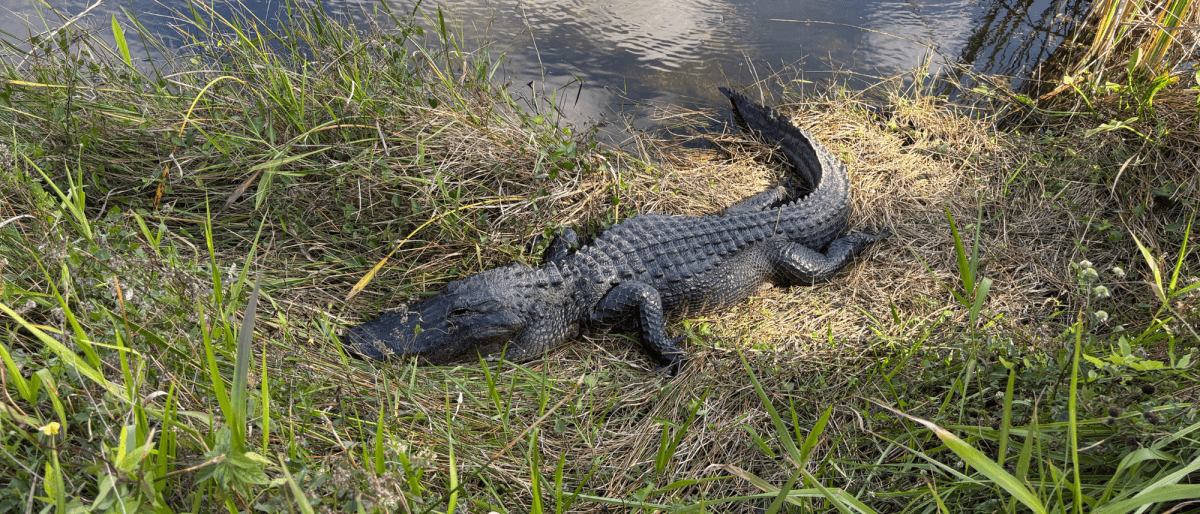
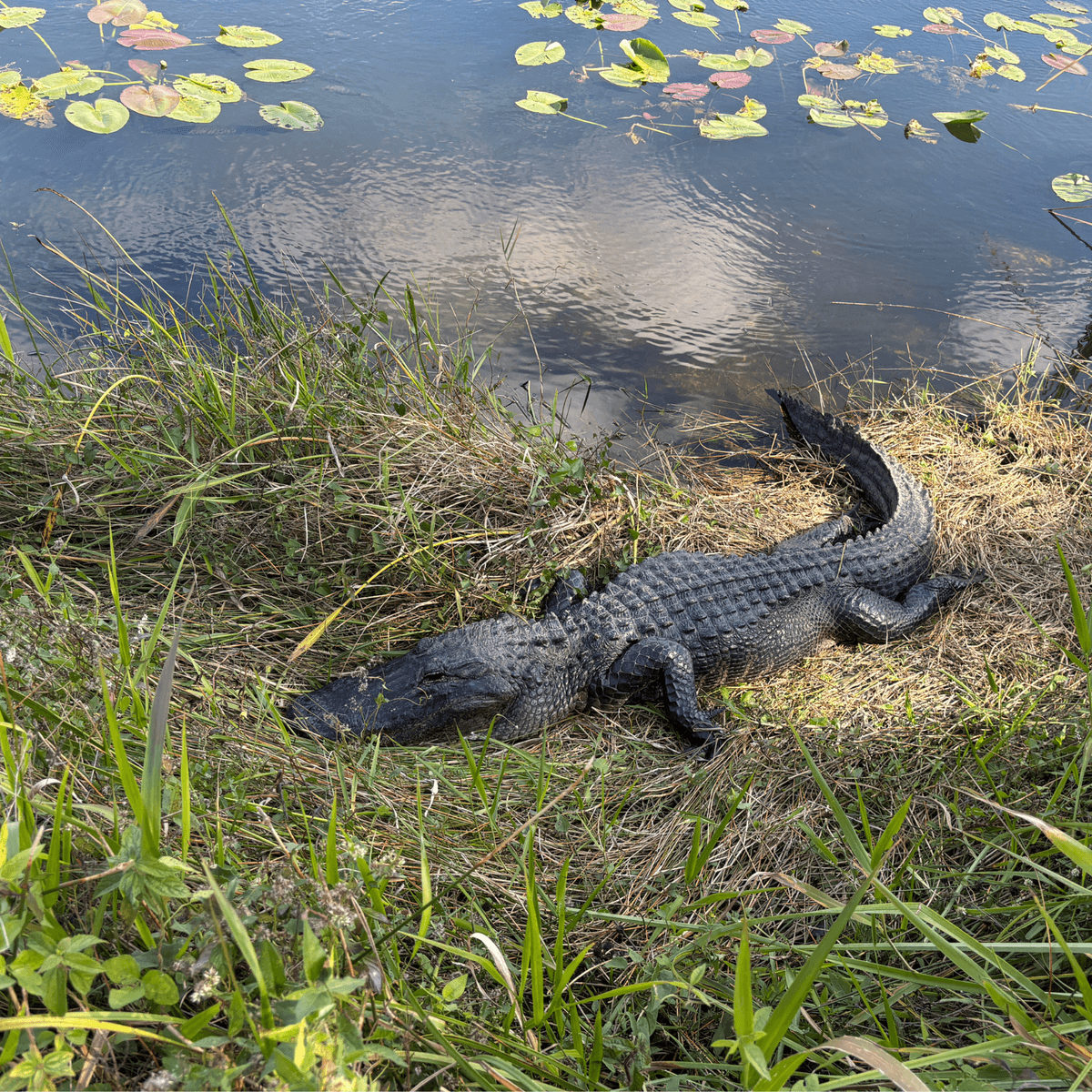
Photo Credit 1: Alligator on the edge of a pond. Eckerd College HERP lab.[26]Eckerd College HERP lab, September 3, 2025. Alligator on the edge of a pond
References
- [1]Augustine, L., Pryes, K., & Evans, M., (2017). Social behavior in captive Cuban crocodiles (Crocodylus rhombifer) at the Smithsonian’s National Zoological Park. Herpetol Rev, 48(1), 75-82 https://www.researchgate.net/publication/315652650_Social_behavior_in_captive_Cuban_crocodiles_Crocodylus_rhombifer_at_the_Smithsonian's_National_Zoological_Park
- [2]Baker, C. J., Class, B., Dwyer, R. G., Franklin, C. E., Campbell, H. A., Irwin, T. R., & Frère, C. H. (2024). Active crocodiles are less sociable. Philosophical Transactions of the Royal Society B Biological Sciences, 379(1912). https://doi.org/10.1098/rstb.2022.0528
- [3]Boucher, M., Tellez, M., & Anderson, J. (2021). Activity budget and behavioral patterns of American crocodiles (Crocodylus acutus) in Belize. Herpetological Conservation and Biology, 16, 86–94. https://www.researchgate.net/publication/356536288_Activity_Budget_and_Behavioral_Patterns_of_American_crocodiles_Crocodylus_acutus_in_Belize
- [4]Crisante, A., Burman, O. H., & Wilkinson, A. (2023). Does ownership impact perception of reptile cognitive abilities and welfare needs? Applied Animal Behaviour Science, 268, 106067. https://doi.org/10.1016/j.applanim.2023.106067
- [5]Crowe-Riddell, J. M., & Lillywhite, H. B. (2023). Sensory systems. In Health and welfare of captive reptiles (pp. 45-91). Cham: Springer International Publishing. https://doi.org/10.1017/awf.2023.92
- [6]Delbosc, N. C., Boyer, N., Mathevon, N., & Grimault, N. (2025). Crocodile mothers’ response to hatching calls. Animal Behaviour, 220, 123040. https://dio.org/10.1016/j.anbehav.2024.11.018
- [7]Fuchs, M. (2015). ‘They are a fact of life out here’: The Ecocritical Subtexts of Three Early-Twenty-First-Century Aussie Animal Horror Movies. In Animal Horror Cinema: Genre, History and Criticism (pp. 37-57). London: Palgrave Macmillan UK. https://doi.org/10.1057/9781137496393_3
- [8]Garrick, L. D., & Lang, J. W. (1977). Social signals and behaviors of adult alligators and crocodiles. American Zoologist, 17(1), 225–239. https://doi.org/10.1093/icb/17.1.225
- [9]Groh, S. S., Upchurch, P., Day, J. J., & Barrett, P. M. (2023). The biogeographic history of neosuchian crocodiles and the impact of saltwater tolerance variability. Royal Society Open Science, 10(10). https://doi.org/10.1098/rsos.230725
- [10]Hansen, A. (2007). Olfactory and solitary chemosensory cells: two different chemosensory systems in the nasal cavity of the American alligator, Alligator mississippiensis. BMC neuroscience, 8(1), 64. https://doi.org/10.1186/1471-2202-8-64
- [11]Ham, A. (2023, August 24). The Quest for a Crocodile Dictionary. The New York Times. https://www.nytimes.com/2023/08/24/science/crocodile-dictionary-vocalizations.html
- [12]Hoser, R. T. (2012). A review of the taxonomy of the living Crocodiles including the description of three new tribes, a new genus, and two new species. Australasian Journal of Herpetology, 14, 9-16. https://www.researchgate.net/publication/325544824_A_review_of_the_taxonomy_of_the_living_Crocodiles_including_the_description_of_three_new_tribes_a_new_genus_and_two_new_speciesAustralasian_Journal_of_Herpetology_A_review_of_the_taxonomy_of_the_livin
- [13]Johnson, L. A., Lobpries, D. S., & Thompson, B. G. (1985). Alligator nuisance control program in Texas: problem and process. https://doi.org/10.3389/fcosc.2021.650339
- [14]Carr, C. E., & Kettler, L. (2019). Neural maps of interaural time difference in the American alligator: a stable feature in modern archosaurs. Journal of Neuroscience, 39(20), 3882–3896. https://doi.org/10.1523/jneurosci.2989-18.2019
- [15]Kofron, C. P. (1991). Courtship and mating of the Nile crocodile (Crocodylus niloticus). Amphibia-Reptilia, 12(1), 39-48. https://doi.org/10.1111/j.1469-7998.1990.tb04014.x?urlappend=%3Futm_source%3Dresearchgate.net%26utm_medium%3Darticle
- [16]Payne, A. R., Mannion, P. D., Lloyd, G. T., & Davis, K. E. (2024). Decoupling speciation and extinction reveals both abiotic and biotic drivers shaped 250 million years of diversity in crocodile-line archosaurs. Nature Ecology & Evolution, 8(1), 121-132. https://doi.org/10.1038/s41559-023-02244-0?urlappend=%3Futm_source%3Dresearchgate.net%26utm_medium%3Darticle
- [17]Pooley, A. C., & Gans, C. (1976). The nile crocodile. Scientific American, 234(4), 114-125. https://doi.org/10.1038/scientificamerican0476-114
- [18]Reber, S. A., Janisch, J., Torregrosa, K., Darlington, J., Vliet, K. A., & Fitch, W. T. (2017). Formants provide honest acoustic cues to body size in American alligators. Scientific Reports, 7(1). https://doi.org/10.1038/s41598-017-01948-1
- [19]Rosenblatt, A. E., Greco, R., Beal, E., Colbert, J., Moore, Y., Baglin, V., & Nifong, J. C. (2023). Golf course living leads to a diet shift for American alligators. Ecology and evolution, 13(9), e10495. https://doi.org/10.1002/ece3.10495?urlappend=%3Futm_source%3Dresearchgate.net%26utm_medium%3Darticle
- [20]Thévenet, J., Kehy, M., Boyer, N., Pradeau, A., Papet, L., Gaudrain, E., Grimault, N., & Mathevon, N. (2023). Sound categorization by crocodilians. iScience, 26(4), 106441. https://doi.org/10.1016/j.isci.2023.106441
- [21]Unravelling the surprisingly complex history of crocodiles | Natural History Museum. (2023, November 17). https://www.nhm.ac.uk/discover/news/2023/november/unravelling-the-surprisingly-complex-hist ory-of-crocodiles.html
- [22]Vergne, A. L., Pritz, M. B., & Mathevon, N. (2009). Acoustic communication in crocodilians: from behaviour to brain. Biological Reviews, 84(3), 391-411. https://doi.org/10.1111/j.1469-185X.2009.00079
- [23]Vergne, A. L., Avril, A., Martin, S., & Mathevon, N. (2007). Parent–offspring communication in the Nile crocodile Crocodylus niloticus: do newborns’ calls show an individual signature?. Naturwissenschaften, 94(1), 49-54. https://doi.org/10.1007/s00114-006-0156-4
- [24]Weldon, P. J., & Ferguson, M. W. (1993). Chemoreception in Crocodilians: anatomy, natural history, and empirical results. Brain Behavior and Evolution, 41(3–5), 239–245. https://doi.org/10.1159/000113845
- [25]Whiting, E. T., & Hastings, A. K. (2015). First fossil Alligator from the late Eocene of Nebraska and the Late Paleogene record of alligators in the Great Plains. Journal of Herpetology, 49(4), 560-569 https://doi.org/10.1670/14-069
- [26]Eckerd College HERP lab, September 3, 2025. Alligator on the edge of a pond
