Bioactive Enclosure Maintenance: Best Practices and Common Mistakes
Learn about keeping your bioactive enclosure running once its set up, from managing plants to the clean-up crew
Orion White
Education Assistant - Herpetological Environments and Research in Practice (HERP) Laboratory, Eckerd College
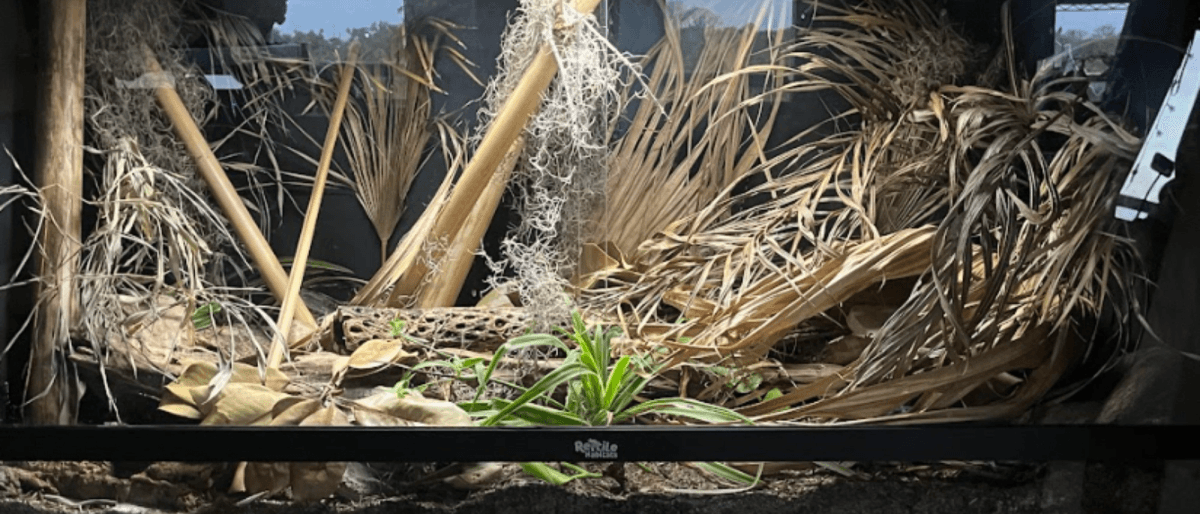
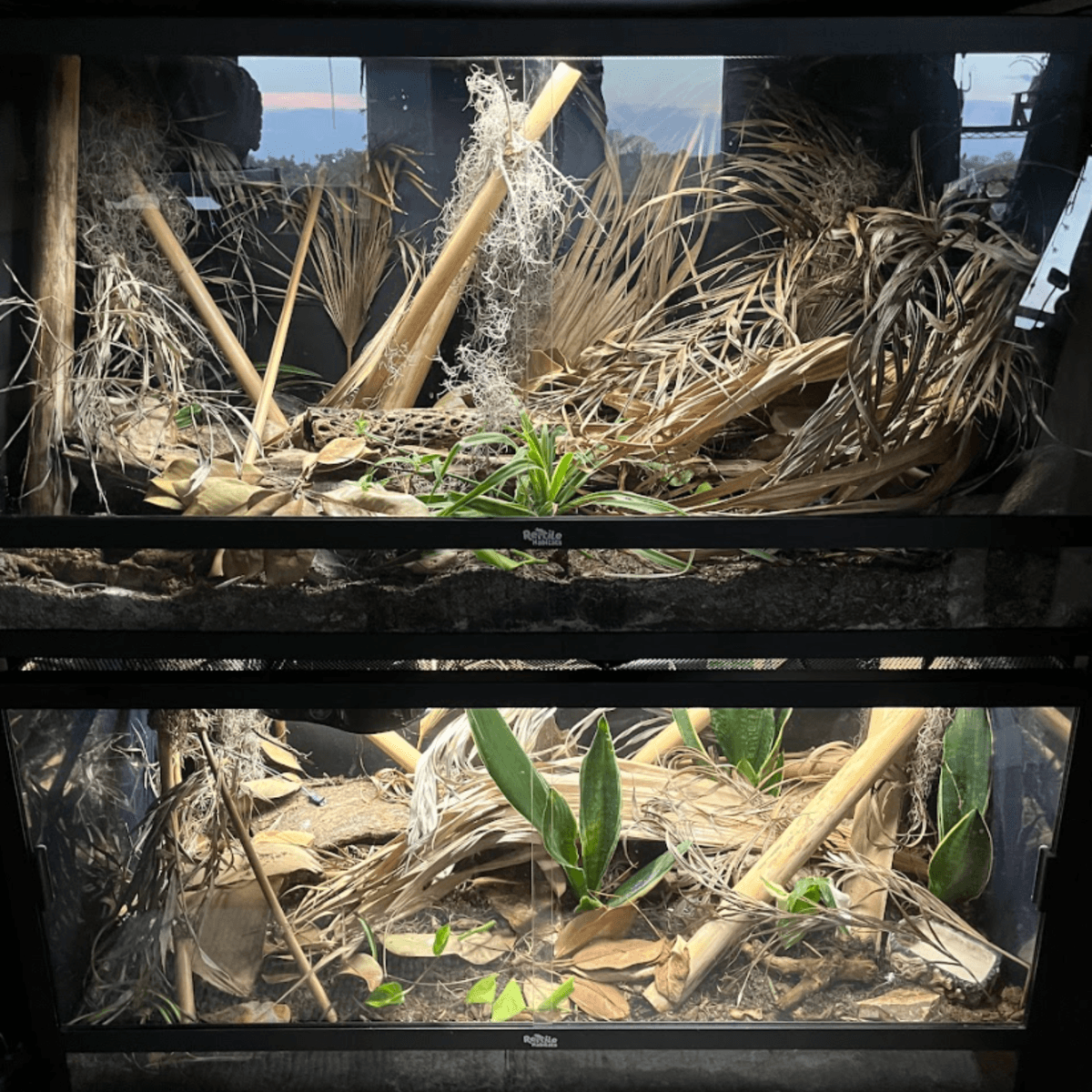
- Your reptile's natural environment should inspire the design of its enclosure.
- Replace food, spot clean the glass, and check the humidity every day.
- Plants play a crucial role in maintaining a balanced humidity level in the environment.
- Daily cleaning is reduced in bioactive enclosures due to the presence of natural decomposers within them.
When designing a Bioactive enclosure, several factors must be considered, including humidity, soil health, and lighting.
Have you been thinking about a bioactive enclosure? Hearing all of the benefits? Having questions about how to maintain one? The first thing to consider is the origin of your reptile, as this will determine the type of soil and plants used in the enclosure. The soil should also be healthy, allowing for beneficial bacterial processes and symbiotic relationships to form with the plant roots to aid in nutrient cycling.[5]Desie, E., Van Meerbeek, K., De Wandeler, H., Bruelheide, H., Domisch, T., Jaroszewicz, B., Joly, F., Vancampenhout, K., Vesterdal, L., Muys, B., & Briones, M. (2020). Positive feedback loop between earthworms, humus form, and soil pH reinforces earthworm abundance in European forests. Functional Ecology, 34(12), 2598–2610. https://doi.org/10.1111/1365-2435.13668View source As a given, you should check the humidity daily and ensure that it stays in the correct range for both the reptile and the plants to avoid mold, rot, and disease within the ecosystem.[4]Davison, E., & Hardy, G. (2023). Getting the best from pot trials with soil-borne Oomycetes. Plant and Soil, 482(1–2), 1–5. https://doi.org/10.1007/s11104-022-05705-wView source The plants will also need an additional grow light, which should emit both blue-cyan and deep red light to promote growth and photosynthesis.[15]Wu, S., Liu, Q., Brik, M. G., Xiong, P., Wang, D., Zhang, G., & Chen, Y. (2022). Bi3+/Mn4+ co‐doped dual‐emission phosphors for potential plant lighting. Journal of the American Ceramic Society, 105(9), 5793–5806. https://doi.org/10.1111/jace.18551View source
To avoid overactive mold growth, the soil needs to be drained and aerated
Ensuring effective bioactive maintenance and cleaning starts with the soil. Firstly, the soil needs to be aerated to effectively support beneficial bacterial processes by allowing water and oxygen to reach the root zone in the enclosure.[12]Svatovskaya, L., Kabanov, A., & Sychov, M. (2017). Soling, Aerating, and Phosphating for Soil Strengthening and Detoxication. Procedia Engineering, 189, 398–403. https://doi.org/10.1016/j.proeng.2017.05.063View source You should also regularly assess the amount of soil in the enclosure and add more if needed to ensure that the plant has the recommended depth for its roots.[4]Davison, E., & Hardy, G. (2023). Getting the best from pot trials with soil-borne Oomycetes. Plant and Soil, 482(1–2), 1–5. https://doi.org/10.1007/s11104-022-05705-wView source The soil should have a drainage layer to reduce the creation of mold. This layer is composed of a false bottom to minimize direct water and soil contact, and in some cases, a tube to drain the excess water. Poorly drained soil will also encourage Oomycetes (a parasite feeding on dead plant matter), which are a sign of poor health for the plant.[4]Davison, E., & Hardy, G. (2023). Getting the best from pot trials with soil-borne Oomycetes. Plant and Soil, 482(1–2), 1–5. https://doi.org/10.1007/s11104-022-05705-wView source [2]Cadena-Iñiguez, J., Arévalo-Galarza, Ma. de L., Aguirre-Medina, J. F., Avendaño-Arrazate, C. H., Cadena-Zamudio, D. A., Cadena-Zamudio, J. D., Soto-Hernández, R. M., Cisneros-Solano, V. M., Ruiz-Posadas, L. del M., Soto-Mendoza, C., & Mejía-Méndez, J. L. (2025). Chayote [Sechium edule (Jacq.) Sw.] Fruit Quality Influenced by Plant Pruning. Horticulturae, 11(8), 965. https://doi.org/10.3390/horticulturae11080965View source
Proper Plant Maintenance Can Promote Reptile Welfare.
The plants that you choose should be close to those found in the native habitat of your reptile. Keeping the plants healthy supports the air quality (removal of CO2 and release of O2) and humidity in the enclosure through photosynthesis.[1]Brilli, F., Fares, S., Ghirardo, A., de Visser, P., Calatayud, V., Muñoz, A., Annesi-Maesano, I., Sebastiani, F., Alivernini, A., Varriale, V., & Menghini, F. (2018). Plants for Sustainable Improvement of Indoor Air Quality. Trends in Plant Science, 23(6), 507–512. https://doi.org/10.1016/j.tplants.2018.03.004View source After setting up your enclosure, ensure you water the plants if they need more than just humidity.[5]Desie, E., Van Meerbeek, K., De Wandeler, H., Bruelheide, H., Domisch, T., Jaroszewicz, B., Joly, F., Vancampenhout, K., Vesterdal, L., Muys, B., & Briones, M. (2020). Positive feedback loop between earthworms, humus form, and soil pH reinforces earthworm abundance in European forests. Functional Ecology, 34(12), 2598–2610. https://doi.org/10.1111/1365-2435.13668View source Plants should be pruned regularly to prevent encroachment throughout the enclosure, which could limit the available space for both the clean-up crew and your reptile.[2]Cadena-Iñiguez, J., Arévalo-Galarza, Ma. de L., Aguirre-Medina, J. F., Avendaño-Arrazate, C. H., Cadena-Zamudio, D. A., Cadena-Zamudio, J. D., Soto-Hernández, R. M., Cisneros-Solano, V. M., Ruiz-Posadas, L. del M., Soto-Mendoza, C., & Mejía-Méndez, J. L. (2025). Chayote [Sechium edule (Jacq.) Sw.] Fruit Quality Influenced by Plant Pruning. Horticulturae, 11(8), 965. https://doi.org/10.3390/horticulturae11080965View source Weekly pruning that removes dead and decaying matter helps the plant stay healthy by optimizing energy output.[2]Cadena-Iñiguez, J., Arévalo-Galarza, Ma. de L., Aguirre-Medina, J. F., Avendaño-Arrazate, C. H., Cadena-Zamudio, D. A., Cadena-Zamudio, J. D., Soto-Hernández, R. M., Cisneros-Solano, V. M., Ruiz-Posadas, L. del M., Soto-Mendoza, C., & Mejía-Méndez, J. L. (2025). Chayote [Sechium edule (Jacq.) Sw.] Fruit Quality Influenced by Plant Pruning. Horticulturae, 11(8), 965. https://doi.org/10.3390/horticulturae11080965View source Pruning can protect against oomycetes, also known as water molds, which appear as spots of discoloration on plants and cause harm.[13]Thines, M. (2018). Oomycetes. Current Biology, 28(15), R812–R813. https://doi.org/10.1016/j.cub.2018.05.062View source However, over-pruning can also harm the plant.[11]Suchocka. (2021). Impact of heavy pruning on development and photosynthesis of Tilia cordata Mill. trees. PloS One., 16(8). https://doi.org/10.1371/journal.pone.0256465View source Ensure that you replenish soil nutrients to support the continuous growth of the plants. Since we cannot use fertilizers, which may be toxic to reptiles, the clean-up crew keeps nutrients cycling. A good way to introduce more nutrients is to add leaf litter, allowing the clean-up crew to replenish the soil.[1]Brilli, F., Fares, S., Ghirardo, A., de Visser, P., Calatayud, V., Muñoz, A., Annesi-Maesano, I., Sebastiani, F., Alivernini, A., Varriale, V., & Menghini, F. (2018). Plants for Sustainable Improvement of Indoor Air Quality. Trends in Plant Science, 23(6), 507–512. https://doi.org/10.1016/j.tplants.2018.03.004View source
How to maintain the clean-up crew.
The next crucial thing is to keep your clean-up crew in check. There needs to be a sustainable number of clean-up crew members to avoid a cycle crash. The clean-up crew should be a mixture of hexopods and isopods that help with decomposition.[10]Quesnel, M. (2019). Amélie Nothomb, Soif, Albin Michel, 2019, 162 pages, 17,90 €. Études, Novembre(11), I–I. https://doi.org/10.3917/etu.4265.0119aView source [7]Ortiz-Ramírez, G., Hernández, E., Pinto-Pacheco, S., & Cuevas, E. (2010). The Dynamics of Soil Mesofauna Communities in a Tropical Urban Coastal Wetland: Responses to Spatiotemporal Fluctuations in Phreatic Level and Salinity. 25. https://doi.org/10.3390/arthropoda2010001View sourceThanks to these guys, you will not have to clean up as much of your reptiles' waste matter, if at all! Each species in the clean-up crew has a special way in which it contributes to the cleanliness of the enclosure. For example, isopods, commonly known as woodlice, have a significant effect on nutrient cycling in the soil.[6]Heffner, T., Brami, S. A., Mendes, L. W., Kaupper, T., Hannula, E. S., Poehlein, A., Horn, M. A., & Ho, A. (2023). Interkingdom interaction: the soil isopod Porcellio scaber stimulates the methane-driven bacterial and fungal interaction. ISME Communications, 3(1), 62. https://doi.org/10.1038/s43705-023-00271-3View source In the wild, woodlice also help with decomposing leaf litter.[14]Van Gestel, C. A. M., Loureiro, S., & Zidar, P. (2018). Terrestrial isopods as model organisms in soil ecotoxicology: a review. ZooKeys, 801(801), 127–162. https://doi.org/10.3897/zookeys.801.21970View source This could be helpful for reptiles that need their enclosure to resemble a forest floor. Earthworms help in decomposition in more acidic soils.[5]Desie, E., Van Meerbeek, K., De Wandeler, H., Bruelheide, H., Domisch, T., Jaroszewicz, B., Joly, F., Vancampenhout, K., Vesterdal, L., Muys, B., & Briones, M. (2020). Positive feedback loop between earthworms, humus form, and soil pH reinforces earthworm abundance in European forests. Functional Ecology, 34(12), 2598–2610. https://doi.org/10.1111/1365-2435.13668View source The last of the common clean-up crew is the springtail, which aids in transferring energy to the soil and above-ground ecosystems.[8]Potapov, A. M., Guerra, C. A., van den Hoogen, J., Babenko, A., Bellini, B. C., Berg, M. P., Chown, S. L., Deharveng, L., Kováč, Ľ., Kuznetsova, N. A., Ponge, J.-F., Potapov, M. B., Russell, D. J., Alexandre, D., Alatalo, J. M., Arbea, J. I., Bandyopadhyaya, I., Bernava, V., Bokhorst, S., … Scheu, S. (2023). Globally invariant metabolism but density-diversity mismatch in springtails. Nature Communications, 14(1), Article 674. https://doi.org/10.1038/s41467-023-36216-6View source You need to monitor the population closely. If you cannot actively see your clean-up crew, especially after rooting around in the soil, you may need to increase the population. Once fully established and balanced, there will be spikes in the population of your clean-up crew, but your reptile within the enclosure could help control them by eating them.[9]Rickman, E. L., Wilkinson, A., Pike, T. W., & Burman, O. H. P. (2025). The impact of enriched housing on the behaviour and welfare of captive leopard geckos (Eublepharis macularius). Applied Animal Behaviour Science, 283, Article 106487. https://doi.org/10.1016/j.applanim.2024.106487View source
Maintaining a bioactive enclosure requires consistency, but when done right, it creates a thriving ecosystem that supports both reptiles and plants. By balancing soil health, plant care, and the clean-up crew, owners can reduce daily chores while improving welfare.[9]Rickman, E. L., Wilkinson, A., Pike, T. W., & Burman, O. H. P. (2025). The impact of enriched housing on the behaviour and welfare of captive leopard geckos (Eublepharis macularius). Applied Animal Behaviour Science, 283, Article 106487. https://doi.org/10.1016/j.applanim.2024.106487View source [3]Crisante, A., Wilkinson, A., Pike, T. W., Rickman, E. L., & Burman, O. H. (2025). Does environmental enrichment impact the behaviour and welfare of bearded dragons (Pogona vitticeps)?. Applied Animal Behaviour Science, 106751. https://doi.org/10.1016/j.applanim.2025.106751View sourceWith proper care, bioactive enclosures offer a healthier, more natural home for reptiles and a rewarding experience for their owners.
Photo Credit: Series of reptile enclosures. HERP Lab, 2025.[16]Eckerd College HERP lab, Sep 26, 2025. series of reptile enclosures.
References
- [1]Brilli, F., Fares, S., Ghirardo, A., de Visser, P., Calatayud, V., Muñoz, A., Annesi-Maesano, I., Sebastiani, F., Alivernini, A., Varriale, V., & Menghini, F. (2018). Plants for Sustainable Improvement of Indoor Air Quality. Trends in Plant Science, 23(6), 507–512. https://doi.org/10.1016/j.tplants.2018.03.004
- [2]Cadena-Iñiguez, J., Arévalo-Galarza, Ma. de L., Aguirre-Medina, J. F., Avendaño-Arrazate, C. H., Cadena-Zamudio, D. A., Cadena-Zamudio, J. D., Soto-Hernández, R. M., Cisneros-Solano, V. M., Ruiz-Posadas, L. del M., Soto-Mendoza, C., & Mejía-Méndez, J. L. (2025). Chayote [Sechium edule (Jacq.) Sw.] Fruit Quality Influenced by Plant Pruning. Horticulturae, 11(8), 965. https://doi.org/10.3390/horticulturae11080965
- [3]Crisante, A., Wilkinson, A., Pike, T. W., Rickman, E. L., & Burman, O. H. (2025). Does environmental enrichment impact the behaviour and welfare of bearded dragons (Pogona vitticeps)?. Applied Animal Behaviour Science, 106751. https://doi.org/10.1016/j.applanim.2025.106751
- [4]Davison, E., & Hardy, G. (2023). Getting the best from pot trials with soil-borne Oomycetes. Plant and Soil, 482(1–2), 1–5. https://doi.org/10.1007/s11104-022-05705-w
- [5]Desie, E., Van Meerbeek, K., De Wandeler, H., Bruelheide, H., Domisch, T., Jaroszewicz, B., Joly, F., Vancampenhout, K., Vesterdal, L., Muys, B., & Briones, M. (2020). Positive feedback loop between earthworms, humus form, and soil pH reinforces earthworm abundance in European forests. Functional Ecology, 34(12), 2598–2610. https://doi.org/10.1111/1365-2435.13668
- [6]Heffner, T., Brami, S. A., Mendes, L. W., Kaupper, T., Hannula, E. S., Poehlein, A., Horn, M. A., & Ho, A. (2023). Interkingdom interaction: the soil isopod Porcellio scaber stimulates the methane-driven bacterial and fungal interaction. ISME Communications, 3(1), 62. https://doi.org/10.1038/s43705-023-00271-3
- [7]Ortiz-Ramírez, G., Hernández, E., Pinto-Pacheco, S., & Cuevas, E. (2010). The Dynamics of Soil Mesofauna Communities in a Tropical Urban Coastal Wetland: Responses to Spatiotemporal Fluctuations in Phreatic Level and Salinity. 25. https://doi.org/10.3390/arthropoda2010001
- [8]Potapov, A. M., Guerra, C. A., van den Hoogen, J., Babenko, A., Bellini, B. C., Berg, M. P., Chown, S. L., Deharveng, L., Kováč, Ľ., Kuznetsova, N. A., Ponge, J.-F., Potapov, M. B., Russell, D. J., Alexandre, D., Alatalo, J. M., Arbea, J. I., Bandyopadhyaya, I., Bernava, V., Bokhorst, S., … Scheu, S. (2023). Globally invariant metabolism but density-diversity mismatch in springtails. Nature Communications, 14(1), Article 674. https://doi.org/10.1038/s41467-023-36216-6
- [9]Rickman, E. L., Wilkinson, A., Pike, T. W., & Burman, O. H. P. (2025). The impact of enriched housing on the behaviour and welfare of captive leopard geckos (Eublepharis macularius). Applied Animal Behaviour Science, 283, Article 106487. https://doi.org/10.1016/j.applanim.2024.106487
- [10]Quesnel, M. (2019). Amélie Nothomb, Soif, Albin Michel, 2019, 162 pages, 17,90 €. Études, Novembre(11), I–I. https://doi.org/10.3917/etu.4265.0119a
- [11]Suchocka. (2021). Impact of heavy pruning on development and photosynthesis of Tilia cordata Mill. trees. PloS One., 16(8). https://doi.org/10.1371/journal.pone.0256465
- [12]Svatovskaya, L., Kabanov, A., & Sychov, M. (2017). Soling, Aerating, and Phosphating for Soil Strengthening and Detoxication. Procedia Engineering, 189, 398–403. https://doi.org/10.1016/j.proeng.2017.05.063
- [13]Thines, M. (2018). Oomycetes. Current Biology, 28(15), R812–R813. https://doi.org/10.1016/j.cub.2018.05.062
- [14]Van Gestel, C. A. M., Loureiro, S., & Zidar, P. (2018). Terrestrial isopods as model organisms in soil ecotoxicology: a review. ZooKeys, 801(801), 127–162. https://doi.org/10.3897/zookeys.801.21970
- [15]Wu, S., Liu, Q., Brik, M. G., Xiong, P., Wang, D., Zhang, G., & Chen, Y. (2022). Bi3+/Mn4+ co‐doped dual‐emission phosphors for potential plant lighting. Journal of the American Ceramic Society, 105(9), 5793–5806. https://doi.org/10.1111/jace.18551
- [16]Eckerd College HERP lab, Sep 26, 2025. series of reptile enclosures.
Similar articles

Plants for a Bioactive Enclosure, and What You Need to Avoid
Why live plants are important for reptile welfare.

A Brief Introduction to Animal Welfare and How it Applies to Reptile Keeping
Understanding animal welfare is essential to providing good reptile welfare for your pet(s). Learn more with Liam from Reptiles and Research!