Lighting, Heating & Humidity
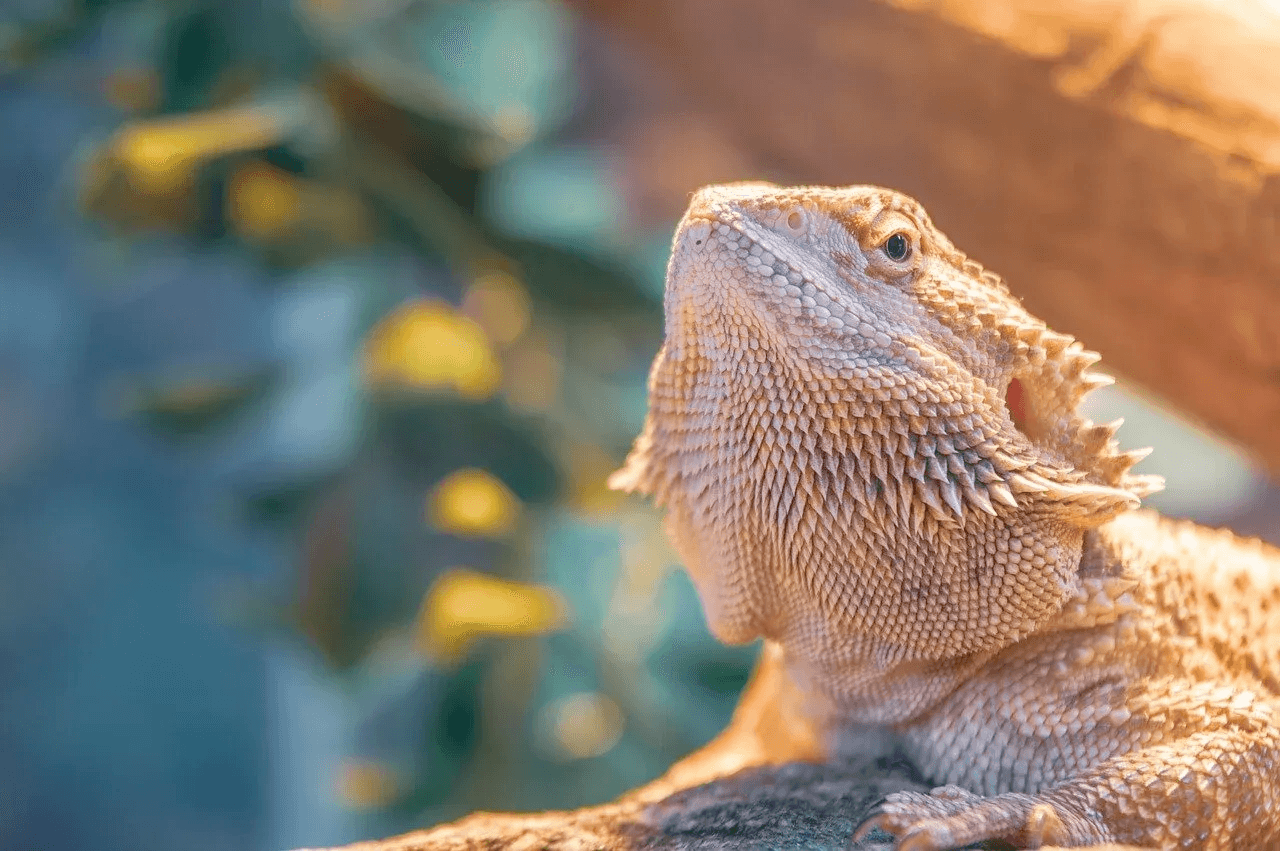
Bearded dragons are diurnal, which means that they are active during the day. And they LOVE the sun. In fact, their parietal (third) eye uses bright light to set the dragon’s circadian rhythm and activity patterns. In other words:
- They must have strong, reliable UVB lighting
- Plenty of bright, white light is needed for energy, appetite, and mental health.
T5 HO Linear Fluorescent UVB
Bearded dragons need a UVI of 4.0-4.5 in their basking area, as measured by a Solarmeter 6.5. The following UVB bulbs are appropriate for use with bearded dragons. Pay attention to the recommended basking distances and adjustments for mesh obstruction, as UVB output/strength varies with distances and whether it’s partially blocked by mesh.
- Arcadia T5 HO Desert 12% UVB kit
- mesh: 11″ /27cm
- no mesh: 16-17″ / 40.5-42cm
- Zoo Med T5 HO Reptisun 10.0 bulb + Arcadia T5 HO lamp fixture
- mesh: 11″ /27cm
- no mesh: 16-17″ / 40.5-42cm
- Arcadia T5 HO Dragon 14% UVB kit
- mesh: 11-12″ /28-30cm
- no mesh: 17-18″ / 43-45cm
(For simplicity, these recommendations assume a ~45% mesh block and the use of an Arcadia T5 HO lamp fixture. For more details on adjusting basking distance based on mesh obstruction, see the Facebook group Reptile Lighting > Guides > Guide 1: Using T5-HO lamps above a Mesh Screen.)
‼️DO NOT use any device/tool for measuring UVI other than the Solarmeter 6.5/6.5R. These are currently the only devices which measure UVI accurately. Using another tool for measuring the output of your UVB lamp may result in harm to your pet!
Extra distancing advice: If you don’t have a Solarmeter 6.5 on hand, I strongly advise adding 1-3″ to the recommended distance to account for your specific dragon’s height. The basking area should be the highest point in the enclosure, and closest to the UVB bulb.
Although not listed above, Reptile Systems- and Exo Terra-brand T5 HO UVB lamps are also high-quality and reliable. Because these UVB lamps work differently from Zoo Med and Arcadia, approximate distancing recommendations cannot be provided on ReptiFiles at this time. Both brands’ charts are accurate when used as directed, but installing them with the help of a Solarmeter 6.5 is strongly advised, especially if you are installing the lamp over mesh.
How long should the bulb be?
For maximum effectiveness and safety, the bulb should be long enough to completely illuminate your beardie’s length, and placed on the warm side, running parallel to the heat lamps, with the heat lamps in the center of the UVB. 22” / 550mm is a good length.
Does fixture (hood) matter?
Yes! The fixture that you mount your UVB bulb can have a large effect on how much UVB your dragon receives. Different UVB brands often use different fixtures, and those specific fixtures are factored in the brand’s information on bulb output.
Make sure to use reptile-specific T5 HO lamp fixtures, as these are highly reflective and designed to optimize both the bulb’s spread and UV penetration. However, not all UVB lamp fixtures work well. For example, although Zoo Med T5 HO UVB bulbs are almost identical to Arcadia’s, their hood fixture dramatically reduces the bulb’s measured UVI at distance compared to Arcadia. Reptile Basics and Exo Terra fixtures are also different in their own ways. Your best bet for ensuring that your bearded dragon is getting a UVI of 4.0-4.5 in its basking area is borrowing or investing in a Solarmeter 6.5!
In addition, make sure that your fixture does not have a piece of glass or plastic to “protect” the bulb. UVB rays are blocked by glass and plastic, rendering that bulb you just spent so much money on completely useless. Naked UVB bulbs are effective UVB bulbs! Don’t believe me? Just read this case from a veterinarian.
What about LED UVB lamps?
As exciting as the idea of an LED UVB lamp is, reptile lighting experts (Frances Baines, Sarina Wunderlich, Thomas Griffiths) have determined that the technology simply isn’t ready for safe use with reptiles yet — REGARDLESS OF WHAT THE MANUFACTURER MAY ASSERT!
How often should you replace the UVB bulb?
UVB bulbs must be replaced regularly to continue to function properly. Just because it’s still producing visible light does NOT mean that it’s still producing UVB! Most high-quality T5 HO UVB bulbs last 12 months before needing replacement, but due to the unique spectrum of Exo Terra bulbs in particular, they need to be replaced every 6 months instead.
For more accurate monitoring of your bulb’s UVB output, I recommend investing in a Solarmeter 6.5. This will help you keep track of the UVI (UV index) within your beardie’s enclosure, and whether it is actually getting too much or too little exposure. According to experts, the optimal UVI gradient for a bearded dragon is 0 to 4.0-4.5, from lowest (furthest from the bulb) to highest (basking area).
NOTE — Certain morphs of bearded dragon with reduced pigmentation (hypomelanistic, translucent) or scaleless (silkback) are likely to be more sensitive to high quantities of UVB. They may need a lower-strength UVB bulb, and should be exposed to UVI of no more than 3.0 in the basking area.
Additional Illumination
Bearded dragons are known as “sun worshippers” — they are incredibly dependent on having plenty of bright white light in their enclosure. This helps promote activity, appetite, and general wellbeing. According to the latest research compiled by Roman Muryn, Dr. Frances Baines, and Quentin Dishman, bearded dragons should have high levels of light in their enclosure, with the brightest spot being between 30,000-59,999 lux. This can be measured with a lux meter, which are fortunately quite inexpensive.
In addition to incandescent heating and UVB, your bearded dragon also needs bright illumination in order to enjoy optimal wellbeing. Aside from making a big difference in your dragon’s health and activity, it also boosts the attractiveness of your setup. Bearded dragons are tetrachromatic, which means that they can see UVA wavelength in addition to the human visual spectrum. Without UVA, their perception of the world is significantly altered. The good news is that UVA is already part of your beardie’s UVB lamp, but additional UVA is required to balance the light coming from other lamps in the setup.
ReptiFiles recommends the following high-output lamps for brightening a bearded dragon enclosure. 75-100% the length of the enclosure needs to be illuminated, which means that you may likely need multiple lamps to do the job.
- BEST: Sol Reptile Vision LED with UVA
- BEST: Faunalux 35w TrueChroma Spot LED with UVA
- Arcadia JungleDawn LED Bar
- Bio Dude Glow & Grow LED
As you install your lamps, make sure the basking area is the brightest area in the enclosure, as this indicates to your dragon where it should bask!
Heating
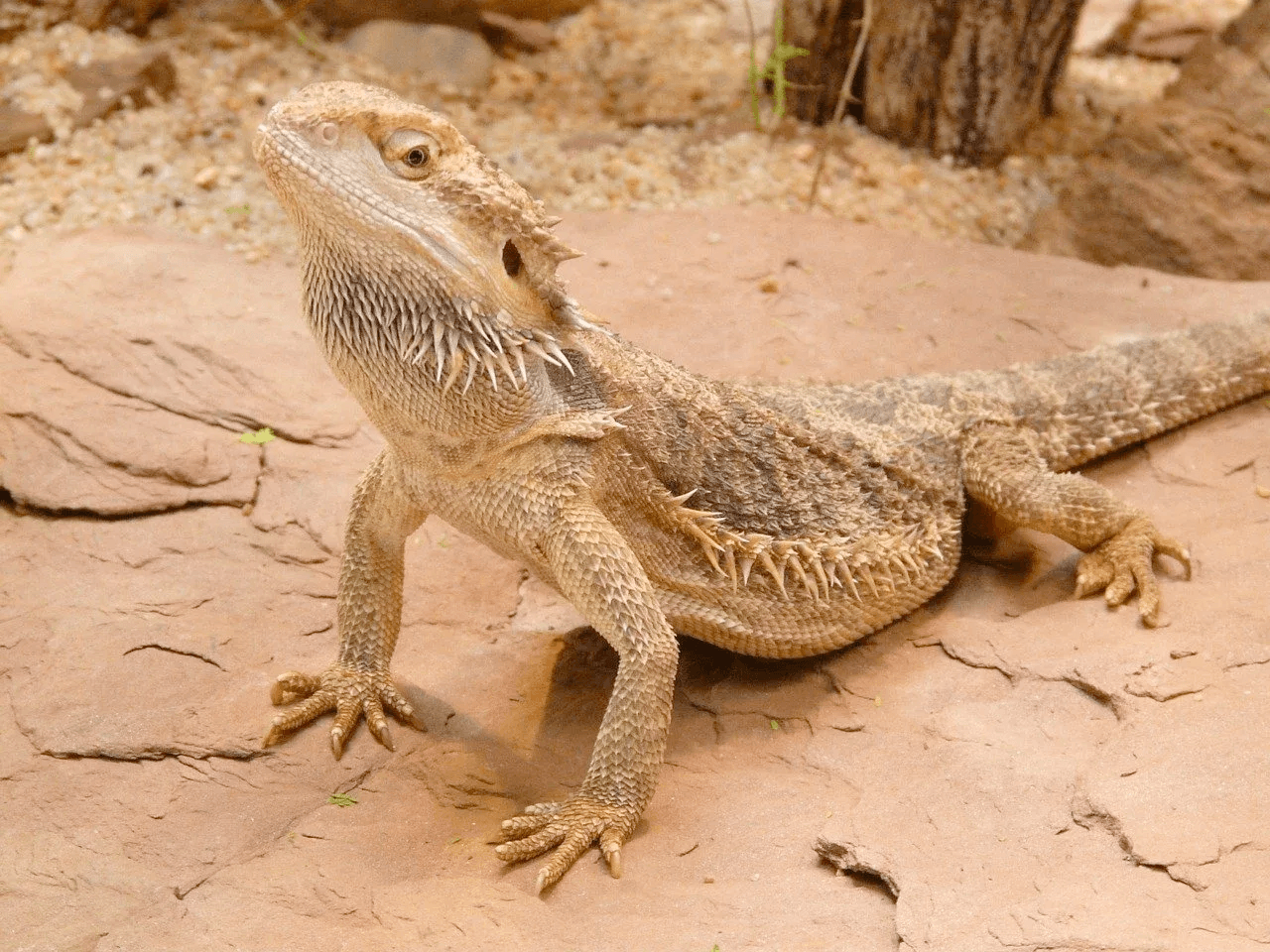
Like all reptiles, bearded dragons need heat to digest and maintain their immune systems. Without it, they get sick and die. Since bearded dragons are basking lizards, they use heat most effectively from an overhead heat source that mimics the sun.
Since they are cold-blooded (specifically, poikilothermic), bearded dragons need a gradient of temperatures in their enclosure in order to be able to regulate their body temperature. Although they can tolerate very high basking temperatures, they need to be able to escape to cooler areas in the enclosure to prevent overheating. For example, if we were looking at an average enclosure from left to right, the highest temperatures should be at the far left, gradually descending to the lowest temperatures on the far right.
- Basking side surface temperature— 108-113°F (42-45°C)
- Cool side surface temperature — 77-85°F (25-29°C)
- Air temperature gradient — 72-99°F (22-37°C)
- Nighttime — 55-75°F (12-24°C)
The recommended basking surface temperature shown above is based on recommendations in Judish Badham’s 1971 PhD thesis, A comparison of two variants of the bearded dragon, Amphibolurus barbatus (Cuvier) (since then verified by Dr. Jonathan Howard), where rectal temperatures of P. vitticeps were taken when the dragons moved away from the sun, showing that they were done basking for the moment, and presumably having reached optimal temperature. Their findings indicated that the optimum core body temperature of central bearded dragons is 36.3°C (97.3°F), which requires basking site temperatures between 42-45°C (108-113°F) to achieve. Dr. Howard’s basking substrate surface temperature measurements suggest that the basking surface in a bearded dragon enclosure does not need to exceed 50°C (122°F), as this risks overheating the enclosure.
If you are using power density to measure the amount of Infrared-A (discussed more later) that your bearded dragon is exposed to while basking, instead of just temperature, you should target basking levels between 300-374W/m², optimally around 325W/m². This is based on recommendations from the Reptile Lighting Guide V10 by Roman Muryn et al.
What should you use for a basking surface?
Surfaces like rocks and logs tend to collect heat over the course of the day, becoming significantly warmer than the surrounding air (for example — have you ever burned yourself on a seat belt buckle even though the air in your car wasn’t that hot?). According to a study by Jane Melville and James Schulte, active body temperatures in Central Australian agamid lizards correlate closely with surface temperatures, which means that measuring basking surface temperature is very important (more on how to measure surface temperature later). For these reasons, a light-colored stone basking surface should be provided, as this material is best at absorbing heat for bearded dragons to use. That said, sturdy basking branches also perform well.
Is it safe for a bearded dragon to have low nighttime temperatures?
Most reptiles benefit from a nightly drop in temperature, which science suggests may promote a healthy metabolism and even strengthen the immune system (rather than weaken it, as commonly believed). Provided that daytime temperatures are correct, pet bearded dragons can handle nighttime drops as low as 50°F without ill effect. In fact, providing cooler temperatures at night encourages beardies to bask in the morning, which subsequently makes for a more active dragon. However, without adequate daytime warming, these cool temperatures may induce brumation or illness.
How to Heat a Bearded Dragon Enclosure
There are lots of ways to heat a reptile enclosure, but not all of them are good practice (or even effective) for a bearded dragon. As it turns out, there are multiple different types of infrared (heat), and the differences between them matter.
Infrared A is the strongest wavelength of infrared, and penetrates deepest into animal tissue for efficient heating. IR-A is naturally produced by the sun, and artificially produced by metal halide and halogen bulbs. This wavelength also has healing properties.
Infrared B is the second-strongest wavelength of infrared, and also has deep penetration properties, but not quite as deep as IR-A. IR-B is naturally produced by the sun, and artificially produced by metal halide and halogen bulbs, as well as deep heat projectors.
Infrared C is the weakest wavelength of infrared, also known as radiant heat. It is unable to penetrate past the skin surface, making it inefficient as a basking heat source. IR-C is produced when IR-A and/or IR-B come in contact with a surface, so it is not produced in significant quantities by the sun. IR-C is artificially produced by deep heat projectors, ceramic heat emitters, radiant heat panels, heat mats, and heat tape.
For more information, read “Next Level Heating: Why Infrared Wavelengths Matter” by Roman Muryn and “Fire — The Sun: Its Use & Replication Within Reptile Keeping” by John Courteney-Smith.
The best way to provide high quality, short-wave infrared heating to your bearded dragon is with incandescent or halogen flood bulbs. In order to create a large enough basking area to evenly heat your pet’s entire body, you will need **at least 2 heat bulbs** placed next to each other.
Best Heat Bulbs for Bearded Dragons
Use a high-wattage halogen bulb inside of a dome heat lamp with a ceramic socket to safely achieve the right basking temperatures and thermal gradient. ReptiFiles recommends using a cluster of at least 2 halogen flood bulbs to provide high-quality Infrared A and B radiation to help your pet thermoregulate most efficiently. I prefer the following bulbs:
BEST: Reptile Systems Infrared Gold Unit, 200-400w
Halogen bulbs (mounted over mesh):
Incandescent spot bulbs (mounted inside the enclosure):
Wattage = heat output. Whether you’re using a 4’x2’x4′ or 6’x2’x2′ enclosure, 90-100w should achieve the temperatures you need. If you need hotter, raise the basking surface (preferably light-colored stone rather than plastic, mesh, or fabric) closer to the heat source. If basking temperature is too low, move the basking surface further away or use a lower-wattage bulb.
Ambient Heating for Bearded Dragons
When setting up a large reptile enclosure, chances are good that basking bulbs alone won’t be enough to create the temperature gradient that your pet needs. If this is the case for your enclosure, you will need to add secondary heat sources to boost your ambient temps.
It’s best to use lightless heating for this purpose, such as:
- Sweeter Heater Radiant Heat Panel
- Arcadia Deep Heat Projector
- Zoo Med ReptiCare Infrared Heat Projector
- Ceramic heat emitter
Use whatever wattage works best to maintain appropriate minimum ambient temperatures — although generally speaking, this means you should be looking at the lowest-wattage options. Depending on the size of your enclosure, you will need 1-2 ambient heaters.
For enclosures taller than 3′, you may need to get handy and install your ambient heating under a ledge about halfway down the enclosure to make sure the cool zone isn’t prohibitively cold during the day. Radiant heat panels work particularly well for this purpose, as they are built specifically to prevent contact burns.
Heat panels and heat projectors should be controlled via rheostat or dimming (proportional) thermostat. Because they produce IR-B and IR-C, you don’t have to worry about negative effects from dimming too much. Ceramic heat emitters are less sensitive and can be controlled via rheostat or on/off (non-proportional) thermostat.
Having trouble with short-lived bulbs?
- Wash your hands thoroughly with soap before installing the bulb. Skin oils can potentially reduce heat bulb’s lifespan.
- Check your heat lamp. Is it rated for the wattage of the bulb(s) you’re using? Does it have a ceramic socket? If not, that’s likely your problem, as well a fire hazard.
- Make sure the lamp is plugged into a surge protector. These bulbs are sensitive to fluctuations in electrical supply, making them more likely to burn out prematurely. A surge protector does what the name implies — protects your bulb from surges.
- Ask yourself: Has the lamp taken a fall recently? The filaments in these bulbs are fragile, likely the result of needing to produce UVA. Jostling or falling while the bulb is hot can prematurely break the filament.
- Contact the manufacturer. If you have done everything correctly, it’s likely that you just got a bad bulb. Check the bulb’s warranty, and if it’s still covered, get in touch with the manufacturer to get it replaced free of charge. For example, the Zoo Med Repti Basking Spot has a 3-month warranty!
How do you make sure you’re doing it right?
First, you need to make sure that you’re getting the right surface temperatures. To measure this, you will need an infrared temperature gun. I got an Etekcity Lasergrip 774 off Amazon, and it’s spectacular.
While using your temp gun, make sure that the basking temperatures cover an area at least as large as the dragon’s entire body (including tail), as hot spots can be dangerous. And don’t take temperature readings until the heat source has been going for about 3 hours, as earlier or later will give you an inaccurate reading.
If you are measuring power density instead, you will need a power density meter like the General Tools BTU1300 Solar Power Meter.
Second, you need to make sure that your air temperatures are high enough. A warm basking surface is no good if the air is too cold, and too high air temperatures can give your dragon heat stroke. Keep track of the air temperature in the basking area with a probe digital thermometer like the Zoo Med Digital Combo Thermometer and Humidity Gauge, which is inexpensive and I have been quite pleased with in my own use.
You need both a temp gun and digital thermometer to get a complete and accurate picture of your bearded dragon’s thermal gradient. One should not be used without the other!
Do you need a thermostat for your basking bulbs?
Thermostats are not necessary for micro-managing basking temperature, and should not be used for that purpose, either. Non-proportional (on/off) thermostats result in an annoying flickering effect, and proportional (dimming) thermostats significantly reduce the Infrared-A output of incandescent bulbs.
However, thermostats are excellent and recommended for use as a failsafe in the event of overheating. This can happen on a hot day, if your air conditioning breaks, etc. By connecting your heat lamps to a non-proportional thermostat with the probe placed on the cool side of the enclosure, you can set the thermostat to shut down the heat lamps in the event that the cool zone gets too hot (99°F / 37°C).
Humidity
Every living creature needs water, even the ones that live in desert environments. Water is available in three main ways:
- drinking
- eating
- humidity
Although it’s good practice to keep a shallow water dish in your bearded dragon’s enclosure, bearded dragons get most of their water from their food and from the air that they breathe. Yes, you read that correctly — they can get water from the air. Granted, it’s not very much water. But this small amount of water from ambient humidity helps keep their lungs, skin, and scales healthy.
A common misconception about bearded dragon husbandry is that humidity should be as low as possible, and any instances of relatively high humidity put the dragon in immediate danger of illness. People who perpetuate this myth forget that Central Australia is not bone dry, and it does rain, and humidity does rise occasionally. It’s also important to note that the average human home significantly drier than outdoors, and sometimes too dry, especially if you live in an area with a naturally dry climate. (Fun fact: the ideal indoor humidity for humans is 40-45%.)
Humidity Levels for Bearded Dragons
The ambient humidity in your bearded dragon’s enclosure should average between 30-60%. You can measure this using a digital probe hygrometer or combo device, with the humidity probe placed on the cool end of the enclosure.
Note that this is the average recommended humidity, not the range that your dragon’s enclosure should stay within at all times. Fluctuations are normal — for example, humidity is usually lower during the day and higher at night. Furthermore, heat and humidity have an inverse relationship. Where it’s hot (such as your basking area), humidity will be low — potentially as low as 10%. Where it’s cool, humidity will be higher. This gradient of temperatures and humidity, as long as they are within correct parameters, will be beneficial, not harmful.
Can too much humidity make your bearded dragon sick?
Yes and no. Bearded dragons deal with humidity spikes all the time in the wild — what keeps them healthy is 1) plenty of fresh air and 2) the opportunity to dry off. A bearded dragon kept in a wet, stagnant environment is bound to get sick. A beardie in a well-ventilated environment with dry substrate and appropriate temperatures/access to infrared-A is unlikely to get sick even if the general humidity is relatively high.
As long as the enclosure gets a chance to warm up and dry out, occasional spikes in humidity due to watering plants in the enclosure, rainy weather, or nighttime are perfectly natural and harmless.
If you have a mesh top but you’re struggling with a perpetually-humid enclosure, I recommend installing a quiet 4” fan on top of the cool end to get the air moving.
If your enclosure has a solid top and you’re struggling with high humidity, you will need a fan (potentially multiple) over the vents to force fresh air through the enclosure.
Don’t forget a humid burrow!
Low humidity can also be harmful to bearded dragons by contributing to dehydration. A dehydrated bearded dragon struggles to shed old skin, suffers from lethargy (“laziness”), and has impaired digestive function, which can lead to conditions like impaction.
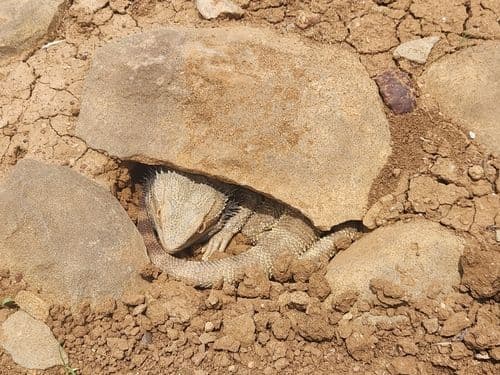
Bearded dragons often shelter in humid burrows in the wild. These burrows can be quite humid (popular YouTuber Dav Kaufman measured 80% during his Australia herping trip), and shelter beardies from extremes of heat and cold, as well as predators. They also help protect beardies from dehydration.
Providing a humid retreat (in addition to other hides) in the enclosure gives your pet a place to find relief when it needs a boost.