Species Library
Common Chuckwalla
Sauromalus ater
Common Chuckwalla Care Sheet
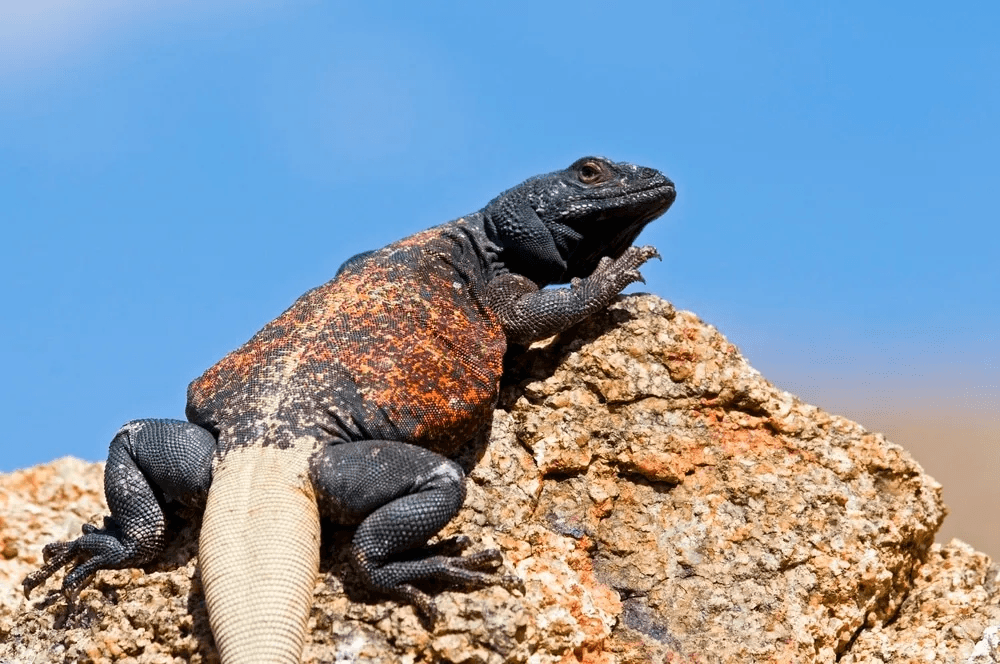
Welcome to the ReptiFiles Common Chuckwalla Care Sheet! This care sheet was written by a professional reptile husbandry researcher, compiled based on reputable sources such as scientific research papers, natural history data, and the experiences of longtime keepers and breeders of this species. You can find a list of these sources at the bottom of this page.
Common chuckwallas are medium-sized, terrestrial, diurnal lizards native to the Mojave and Sonoran deserts of North America. They can be found in extreme southern Utah, southern Nevada, western Arizona, southeast California, Baja California, and western Sonora. These lizards occupy arid habitats with moderate shrub cover and plenty of rocks, and can generally be found near large boulder piles, lava flows, and rock outcrops.
Chuckwallas are generally between 10-18″ / 13-23cm long, with about half of that length being tail. They have a triangular head with small spikes toward the neck, stout body, large belly, wrinkled skin on the neck and along the sides, strong legs, and a thick, blunt-tipped tail. Male common chuckwallas have many variations in color and pattern between populations:
- Black head, black/gray/brown/red or multicolored torso, and light tail
- Gray or yellow speckled
- Gray banded
Females are usually brown or grayish, and may have dark bands on the torso and/or tail. They are generally far lower-contrast than males, with a smaller size and narrower head. Juveniles look like females, but with more banding, particularly on the tail.
Common chuckwallas are manageably-sized, hardy, and usually tame down well, so captive-bred chuckwallas can make excellent pet lizards. With attention to providing correct chuckwalla care, this pet can live up to 30 years old — although older may be possible.
Common Chuckwalla Shopping List
These are products I personally recommend for setting up a functional common chuckwalla enclosure. Some of the links in this care sheet are paid links — if you’d like to know why ReptiFiles uses paid links, visit this page.
Items marked with an * are recommended to be purchased in-person rather than online.
- 48″L x 24″W x 24″H front-opening enclosure, preferably larger
- Zoo Med Combo Deep Dome Dual Lamp Fixture
- 75w Reptile Systems Eco Halogen flood bulbs, x2
- Several large pieces of flagstone or concrete pavers*
- 2”W x 2”H wood spacers*
- Gorilla Glue
- Zoo Med Digital Combo Thermometer Humidity Gauge
- Etekcity 774 infrared thermometer
- 22″ T5 HO Arcadia Dragon 14% UVB kit
- 34″ Arcadia JungleDawn LED Bar
- Zilla 24/7 Digital Power Center
- 2+ cubic ft play sand*
- Environmental enrichment items
- Food and water dishes
- Miner-All Indoor + Vit-All reptile supplements
- Uro Grit supplement
- Dry food
Enclosure Size Requirements for a Common Chuckwalla
A long-term enclosure for a common chuckwalla should be no smaller than 4’L x 2’W x 2’H / 1.2 x 0.6 x 0.6m. The enclosure should be front-opening for easy access, with excellent ventilation. Ideally, the top should be mesh rather than solid, as this makes installing and rearranging all of your lamp fixtures much easier. Alternative dimensions should have at least 8 ft² / 0.75 m² of floor space and no less than 18″ / 45cm of height.
Here are some enclosures that ReptiFiles recommends for housing common chuckwallas:
- Zen Habitats 4’x2’x2′ Meridian Reptile Enclosure
- Dubia.com 4x2x2 (120 Gallon) Reptile Enclosure
- Toad Ranch BC48 4’x2’x2′ Luxury Reptile Enclosure
ReptiFiles strongly recommends providing larger than the minimum. All of the brands listed above also offer larger sizes!
Can multiple chuckwallas be housed together?
Yes, but 1) it’s not required for their psychological wellbeing, and 2) you will need a larger enclosure to do so successfully. If you want to keep a group of chuckwallas instead of just one, keep in mind these rules:
- add at least an extra 12″ / 30cm to the length and width of the enclosure per additional animal
- males should NEVER be housed together, as they will attack each other
- multiple basking sites and extra crevices/hides must be provided to reduce competition
- housing a male together with females will result in eggs. Do not breed reptiles (or any animal, for that matter) without a solid plan for taking care of the pregnant/postpartum female(s) and what you’re going to do with the eggs!
Minor scuffles and conflicts are normal within groups, but if things escalate, be prepared to separate the lizards immediately.
Lighting & UVB for Common Chuckwallas
Chuckwallas are diurnal, which means that they are most active during the day. This also means that they are stimulated by the presence of bright white light in their environment, and they require strong, high-quality UVB lighting for survival.
At minimum, chuckwallas should have 12 hours of light per day. Ideally, they should have a seasonal light cycle of 14 hours of light/day in summer and 8-10 hours of light/day in winter, with gradual adjustments in-between. The easiest way to do this is by syncing your lights with local sunrise/sunset times via smart timers like Kasa.
UVB Lighting
UVB lighting can be tricky, because in order to get the right strength of UVB (UV Index, or UVI), distance and potential mesh obstruction must be considered. Brand, fixture, and bulb type are also important considerations for achieving the right output and effectiveness. Purchasing a random, “off-brand” UVB lamp off of Amazon because it seems to have compelling advertising or offers the lowest price point is a good way to accidentally injure your pet. ReptiFiles also strongly discourages the use of all LED UVB lamps at this time.
To provide enough UVB to a sun-loving chuckwalla, I recommend the 22″ Arcadia T5 HO Dragon 14% UVB kit. The lamp must be placed on the warm side of the enclosure, fully overlapping the heat lamps so that their beams can combine to create a more sun-like basking area. The basking area should be placed to put the chuckwalla’s back at the appropriate distance:
- UVB mounted over mesh: 9-11” / 23-28cm below UVB lamp
- UVB mounted inside enclosure: 14-16” / 36-41cm below UVB lamp
(These recommendations are approximations based on available data, assuming a 45% mesh obstruction rate. For best results, use a Solarmeter 6.5 to determine the best placement to achieve a UVI of 4.5-6.0 in the basking area.)
Your UVB bulb must be replaced every 12 months to maintain effective output, as UVB lamps decline over time — even when the lamp is still emitting visible light!
General Illumination
Bright light with a color temperature of around 6000K is strongly correlated with optimal mental and physical health in sun-loving lizards like chuckwallas. Chuckwallas with additional “daylight” lighting in their enclosure are likely to be more alert and active than those without, as well as demonstrating better appetite and more natural behaviors.
Full-spectrum lighting is not the same as reptile UVB lighting, so you will need two separate lamps. The Arcadia Jungle Dawn LED Bar and Bio Dude Glow & Grow are both excellent lamps for this purpose. You will need at least one long enough to span at least most of the enclosure, or multiple smaller units.
If you have a lux meter, the brightest spot (basking area) in a chuckwalla enclosure should be between 30,000-59,999 lux.
Common Chuckwalla Temperature Requirements
Humans are warm-blooded, which means that our body temperature is automatically regulated. Chuckwallas, however, are cold-blooded, which means that they have to move between areas of different temperatures in order to regulate their body temperature. Chuckwallas warm up by basking under the sun in the wild. In captivity, they do best with incandescent heat lamps or outdoor enclosures.
- Basking surface temperature: 110-125°F (43-52°C)
- Cool zone (ambient) temperature: 78-88°F (26-31°C)
- Nighttime temperature: >65°F (18°C)
If you have a power density meter, target infrared-A levels of 375-449 w/m2 (preferably around 400) in the basking area.
To measure the basking surface temperature, use an infrared thermometer (a.k.a. temperature gun). To passively track basking temperature, use a digital probe thermometer, with the probe placed on the basking surface under the heat source. The Etekcity 774 is a good infrared thermometer, and most reptile-brand digital probe thermometers function well enough.
What heat lamp should you use for a chuckwalla?
In a 4x2x2 enclosure, you will need a cluster of at least 2 heat lamps to create a sufficiently large basking area for one adult chuckwalla. Not all heat lamps are created equal, of course! Incandescent spot bulbs generally have a wider beam and gentler infrared-A output. Halogen flood bulbs generally have a narrower beam and more intense infrared-A output. I prefer spot bulbs when the heat lamp needs to be inside the enclosure or the enclosure top has a low mesh obstruction rate. Halogen flood bulbs often perform best with larger basking distances and/or tightly woven mesh tops.
ReptiFiles’ preferred heat bulbs for chuckwallas:
What wattage? 150w will be a good starting point for basking spot bulbs, and 75w for halogen bulbs. However, the right wattage for your enclosure is highly dependent on outside factors like basking distance, room temperature, mesh obstruction, etc, so expect to do some experimenting.
If you notice that the basking temp is too high or your chuckwalla seems to be avoiding basking directly under the lamps, lower the basking platform or use lower-wattage bulbs. If your basking area is too cool, you will need higher wattage bulbs or to switch to halogens.
DO NOT USE:
Heat mats, heat tape, and electric basking rocks are all inappropriate sources of basking heat for chuckwallas! Ceramic heaters, heat projectors, and radiant heat panels should only be used for supplemental heat if ambient temps in the enclosure are low.
Basking platform
I strongly recommend constructing a special type of basking platform for your chuckwalla called a Retes stack. This is a stack of flat wood or stone pieces with spacers in between to create secure crevices where your pet can feel secure while also choosing the exact temperature it wants to bask at. The base of the stack MUST be in direct contact with the floor of the enclosure in order to prevent the lizard from digging under it — which may trigger catastrophic collapse!
Winter Cooling/Brumation:
It is best practice to brumate common chuckwallas through the winter, as this is something they do regularly in the wild to survive periods of scarce food and low temperatures. Brumation is about more than survival, however; it helps regulate their hormonal rhythm, which is linked to successful breeding and likely plays a role in long-term health.
Day length plays a significant role in triggering brumation, but food availability and temperatures are also important factors. Here’s a sample schedule for brumating a common chuckwalla:
- October 1st — Stop feedings. If not using a smart timer to control photoperiod, begin reducing day length.
- October 15th — Begin reducing duration of basking lamps.
- November 1st — Basking lamps should only be on for 1.5 hours/day at this point, with a day length of 8-10 hours.
- January 1st — If not using a smart timer to control photoperiod, start increasing day length.
- February 1st — Day length should be back up to 12-14 hours by now. Start increasing duration of basking lamps to normal.
- February 15th — Basking lamp duration should be normal by now. Restart feedings.
*If you live in the southern hemisphere, brumation should start in February and end in October.
Additional notes: Gradual transitions are key to helping your chuckwalla brumate in a healthy way. Temperatures should never drop down below 48°F (9°C). Never feed a chuckwalla during brumation, as low temperatures prevent proper digestion and can be life-threatening!
DO NOT BRUMATE A SICK OR UNDERWEIGHT REPTILE. If your pet seems to be losing a significant amount of weight or otherwise unhealthy during brumation, see a vet immediately.
Common Chuckwalla Humidity Requirements
Common chuckwallas are not very picky when it comes to humidity. They have been kept in areas with low humidity as well as higher humidity, with no apparent affect on their wellbeing. Of course, they’re still an arid species, so a wet environment will certainly cause problems. Make sure your chuckwalla has consistent access to a humid hide and ambient humidity levels largely between 15-65%, and you should have nothing to worry about.
To measure humidity levels, use a digital probe hygrometer with the probe on the substrate in the middle of the enclosure. To create a humid hide, place a hide box/cave on the cool half of the enclosure with lightly moistened substrate or sphagnum moss inside. The easiest way to do this is to make use of one of your rock stacks on the cool end of the enclosure (see Environmental Enrichment section for more).
Substrate Options for Common Chuckwallas
Chuckwallas are healthiest and happiest when they are housed on a substrate (a.k.a. “bedding”) that replicates the conditions of their natural habitat. In the Mojave and Sonoran deserts, that substrate is typically fine, packed sand. That means the substrate in your chuckwalla’s enclosure should be fine sand or sandy soil, packed at least 3” deep for digging — preferably deeper, if at all possible. In a 4x2x2 enclosure, that takes at least 2 cubic ft of substrate, or ~190 lbs of sand.
Here are some naturalistic substrate options appropriate for using with common chuckwallas:
- Jurassic Natural Australian Desert Dragon Habitat
- Jurassic Reptile Substrate
- Zoo Med ReptiSand
- Exo Terra Desert Sand
- Play sand (washed to remove dust)
Alternatively, you can also make your own DIY desert mix of 50% play sand, 30% organic topsoil, and 20% Zoo Med Excavator Clay.
Sick or wounded chuckwallas should not be kept on loose substrate. Instead, use paper towels.
Environmental Enrichment: Decorating the Terrarium
Decorations play an important role in a reptile’s enclosure as environmental enrichment. Enrichment items encourage natural behaviors, promote exercise, stimulate your pet’s natural instincts, and help promote overall wellbeing. And, of course, they make the enclosure look nice!
For common chuckwallas, the most important type of decor is stone: light-colored flagstone, flat chunks of sandstone, concrete pavers, and even cinder blocks! Although they do take advantage of the occasional burrow, common chuckwallas are primarily crevice-dwellers closely associated with rock formations; rocks are what they hide between, climb on, and bask on.
If you want to make a rock stack in your enclosure, make sure to anchor it to the bottom of the enclosure and reinforce it against shifting, which can potentially crush a chuckwalla! Gorilla Glue works well for sticking stones together in a terrarium. However, make sure to keep the interior of the stack accessible in case you need to get your pet out of there in a hurry.
After stone, there are some other materials you can use to add variety and attractiveness to your enclosure. For example, wild chuckwallas are known to climb the branches of low foliage to eat otherwise hard-to-reach leaves and flowers. You don’t need all of these things, but you do need enough of them to provide plenty of places to hide and opportunities to climb/explore.
- artificial rock hides
- cork flats
- cholla wood
- ghost wood
- grape wood
- drought-tolerant, nontoxic live plants*
- magnetic ledges
- 3D background
*These are likely to get eaten and will need replacing regularly. Consider yourself warned.
One of the most common errors in reptile keeping is keeping the animal in a relatively sparse enclosure. Minimalism is not the goal here — your goal is to squeeze as much use out of the enclosure’s volume as possible in order to make it maximally functional as an animal’s living space.
For ideas on how to set up and decorate your enclosure, I recommend scrolling through photos of chuckwallas in their natural habitat on iNaturalist!
Feeding Your Common Chuckwalla
Chuckwallas are herbivores, which means that they need a primarily plant-based diet to get the nutrition that their bodies need. How often and how much they need to eat depends on age. Juvenile chuckwallas should be fed daily, as much as they can eat. Adults should be fed 4-5x/week.
Phil Lietz of Arids Only recommends that 85% of a pet chuckwalla’s diet should be greens/plants/flowers, 10% dry foods, and 5% insects and seeds. The key to providing a healthy, balanced diet for your chuckwalla is VARIETY, so use as many as possible!
For a bit of fun, challenge your chuckwalla by making it work for its food (as keeps them busy in the wild). You can place little piles of food in different places around the enclosure, “hide” the food, hang a bouquet flowers and greens from a string, or even try your hand at target training.
Safe greens:
- collard greens
- mustard greens
- cactus pad
- spring mix
- arugula
- kale
- pea shoots/sprouts
- alfalfa
- carrot greens
- spinach
- dandelion greens
- hibiscus leaves
- clover
- frisee
- grape leaves
- curly endive
- treviso
- raddichio
- romaine lettuce
- green leaf lettuce
- bok choy
- turnip greens
- grass
- bindweed
- broadleaf plantain (Plantago major)
More options for leafy greens to feed to your chuckwalla can be found at The Tortoise Table. Wild, pesticide-free “weeds” foraged from outdoors should make up as much of your pet’s greens intake as possible, as wild plants are actually better for reptiles than the ones bred and raised for human consumption in the grocery store.
Safe flowers:
- clover
- dandelions
- hibiscus
- rose petals
- squash blossoms
- nasturtium
- phlox
- vine weed/bindweed
- honeysuckle
- sunflower petals
- Arids Only Uro Bloom
Flowers can be fed ad libitum, especially in the spring. Most chuckwallas go nuts for dandelions! Make sure that flowers are free of pesticides (ornamental flowers from a flower shop are NOT appropriate!).
Vegetables:
Hard vegetables should be cooked or finely chopped/shredded before offering.
- Acorn squash
- Butternut squash
- Carrots
- Green beans
- Green peas
- Opuntia cactus
- Spaghetti squash
- Zucchini
Dry foods:
Fresh greens should comprise the bulk of your chuckwalla’s diet, but certain commercial herbivore diets can be a good way to add variety and extra nutrients. This is especially the case if most of your pet’s greens come from the grocery store. These can be offered dry or soaked, alone or with fresh food.
- Arids Only Uro Spice
- SuperChuckwalla blends
- Zoo Med Natural Grassland Tortoise Food
- Mazuri Herbivorous Reptile Diet
- Rep-Cal Juvenile Iguana Food
- Tortoise Supply Herbal Tortoise Hay
- Arcadia Optimised 52
Seed options:
Interestingly, chuckwallas also need seeds (ex: lentils, white millet) as a regular part of their diet. These provide an important source of protein, fat, and other nutrients, BUT contribute to obesity when fed in excess. Offer a small amount no more than 1x/week. The Uro Grit supplement is a great way to meet this requirement.
Treats:
Insects can be used as a treat in moderation! Stick to one bug no more than 1x/week for juveniles and every other week for adults. The feeder should be small enough for the lizard to handle easily, but large enough to catch its eye. Appropriate options to try include mealworms, superworms, crickets, grasshoppers, locusts, and spiders.
Although too much dietary protein can certainly cause problems for chuckwallas, they do still eat the occasional bug out in the wild. This is a valuable source of additional nutrients that rounds out their nutrition and combats nutrient deficiency, especially during times when plant food is scarce. Feeder insects should always be dusted with 50/50 calcium and multivitamin (Miner-All and Vit-All are a good pairing) before feeding.
Supplements
To ensure that your chuckwalla is getting all of the vitamins and minerals that they need, you will need to sprinkle some calcium powder and a multivitamin powder on their greens. Miner-All and Vit-All as mentioned previously work well for chuckwallas, or you can use Repashy Superveggie for an all-in one. This should be added to your pet’s food 2x/week.
Adding Repashy Superpig to your routine can help enhance your pet’s coloring as a source of extra carotenoids.
Bee pollen is frequently recommended for this genus, but often offered in unhealthy high quantities. Instead, let your chuck get its pollen fix from edible flowers or Uro Bloom instead. Use as directed by the label.
Drinking Water
Chuckwallas are well adapted to living in drought conditions and get most of the water they need from their food. However, a small bowl of fresh water should still always be available.
Handling Your Common Chuckwalla
Common chuckwallas are largely docile and generally tame down well. That said, it’s important to remember that each is its own individual. Some tame faster than others, while some never become tame at all. This may take a while, so be patient! Captive-bred chuckwallas are likely to be more tameable than wild-caught individuals, and juveniles are generally much more skittish than adults.
- After bringing your chuckwalla home, leave it alone for 2 weeks or so to settle in. If your new pet hasn’t eaten by the time the 2 weeks are over, do not handle and make an appointment with an experienced reptile vet.
- Introduce yourself with food via your fingers or soft-tipped feeding tongs. Meanwhile, make sure to get your hands in the enclosure daily for spot cleaning, water changes, etc. This will help get it get used to you.
- Once your pet regularly takes food from your hand, encourage it to climb onto your hand. For example, place the food so it has to climb onto you to get it.
To pick up your chuckwalla, always gently scoop it up from below and support as much of its body as possible. Never approach quickly or from above, as this is predatory behavior that will scare your pet. As you handle your chuckwalla, keep your movements slow, and only loosely restrain it (if at all). “Treadmilling” it from one hand to the other can help prevent the animal from jumping/running out of your hands.
Hygiene
Quarantine
If you have other reptiles in your home (especially other Sauromalus!), it’s important to place your new pet in a basic quarantine setup for up to 6 weeks, away from contact with your other animals. During this time, take your new pet to an experienced reptile vet for an initial checkup, do any relevant testing for disease or parasites, and generally monitor their health.
It’s much easier to keep track of a reptile’s health in a quarantine setup than a fully-enriched habitat. For information on how to quarantine new reptiles, see this article and video: How to Quarantine Reptiles.
Keeping the Enclosure Clean
Feces and urates should be removed immediately, and contaminated substrate should be scooped out and replaced. Substrate should be completely replaced once every 6-12 months, depending on how diligent you are about spot-cleaning.
If water spots accumulate on the glass, use white vinegar and a paper towel to remove them. Rinse afterward to remove remaining residue and odor. If the odor of white vinegar bothers you, you can use lemon juice instead — although you will have to do a bit more scrubbing.
1x/year, do a complete cleanout of the enclosure. Remove all substrate and decor. Give the decor a good scrub with hot water. Wash the walls and floor, then follow with veterinary-grade disinfectant (Rescue, F10SC, or 10% bleach solution). Use the disinfectant according to the directions on the label, paying special attention to contact time and rinse requirements.
Handling Hygiene
Wash your hands or put on a new pair of disposable gloves before handling.
Never eat or put anything else in your mouth during handling.
After handling the lizard or performing maintenance on the enclosure, make sure to scrub your hands thoroughly with soap and water. If that isn’t possible, apply a generous amount of alcohol-based hand sanitizer.
If you were handling a reptile of unknown health, remove and wash your clothes before coming into contact with your own reptiles, in addition to washing your hands.
References
Aucone, B. (2004). Captive Husbandry of the Chuckwalla (Sauromalus ater). Iguana, 11(2), 114-118. https://journals.ku.edu/iguana/article/view/17100
Common Chuckwalla. (n.d.). The Center for North American Herpetology. Retrieved June 10, 2026, from https://cnah.org/taxon.aspx?taxon=Sauromalus_ater
Full Sun Baskers. (n.d.). Arcadia Reptile. Retrieved June 10, 2026, from https://arcadiareptile.com/lighting/full-sun-baskers/
Innovative Ectotherms. (2016, July 25). Common Chuckwalla (Sauromalus ater). ReptileTalk NET. https://www.reptiletalk.net/common-chuckwalla/
Jones, L. L. C., & Lovich, R. E. (n.d.). Lizards of the American Southwest: A Photographic Field Guide (pp. 135–138). Rio Nuevo Publishers.
Kaplan, M. (2001). Chuckawalla and Desert Iguana. Melissa Kaplan’s Herp Care Collection. https://www.anapsid.org/dichuck.html
Lietz, P. (n.d.). Chuckwalla Care Guide. Arids Only. Retrieved June 10, 2026, from https://aridsonly.com/pages/chuckwalla-care-guide
Montanucci, R. R. (1997). Captive Management, Behavior and Conservation of Chuckwallas, Sauromalus obesus (Lacertilia: Iguanidae). Chicago Herp Society Bulletin, 32(6), 121–137. https://library.iucn-isg.org/documents/1997/Montanucci_1997_Bulletin_of_the_Chicago_Herpetological_Society.pdf
Muryn, R., Baines, F., & Dishman, Q. (2025). Reptile Lighting Guide V10. https://reptifiles.com/wp-content/uploads/2026/01/20260121-The-Reptile-Lighting-Guide-V10.pdf
Schofield, E. (2009). Chuckwalla Care Guide and Photos – BambooZoo. BambooZoo. https://bamboozoo.weebly.com/feature-chuckwalla.html
5632Schultz, T. 2014. “Sauromalus ater” (On-line), Animal Diversity Web. Accessed June 5, 2026 at https://animaldiversity.org/accounts/Sauromalus_ater/. Last updated: 2014-03-09 / Generated: 2026-03-29 20:10