Help! My Bearded Dragon Won’t Eat Greens
A common concern expressed by new keepers is that their bearded dragon won't eat greens. Troubleshoot your dragon's pickiness with this post by ReptiFiles.
Mariah Healey
Founder, ReptiFiles

Updated: January 8, 2024
One of the most common questions I get on Instagram is, “My bearded dragon won’t eat greens. What am I doing wrong??!” As a reptile husbandry researcher, I have found that most health and even behavioral problems in reptiles can usually be traced back to their husbandry. Beardies can refuse greens for a variety of reasons, but as long as they’re still eating, it’s usually a pretty straightforward fix.
Reason #1: Age
Bearded dragons’ nutritional needs change as they grow. They need a lot of bugs in their first year of life to fuel rapid growth, so don’t be too concerned if they don’t seem keen on vegetables yet. Greens can be an acquired taste, so one of the best ways to introduce your beardie is by keeping a bowl of fresh greens in the terrarium at all times.
- Hatchlings (0-3 months old)
- Insects 1x/day, as many as the dragon will eat
- Vegetables daily, as much as the dragon will eat
- Calcium powder on all insects and salads
- Multivitamin powder on salads 2x/week
- Juveniles (<12″/25cm long)
- 5-6 head-sized insects daily, or equivalent portion
- Vegetables daily (3x larger than insect volume)
- Calcium powder on all insects and salads
- Multivitamin powder on salads 2x/week
- Subadults and Adults (>12″/25cm long)
- 3-4 head-sized insects 2x/week, or equivalent portion
- Vegetables 3x/week (one portion = size of dragon’s head)
- Calcium powder on all insects and salads
- Multivitamin powder on salads 1x/week
- Gravid females
- 4-5 head-sized insects 2x/week, or equivalent portion
- Vegetables 3x/week (one portion = size of dragon’s head)
- Calcium powder on all insects and salads
- Multivitamin powder on salads 2x/week
This feeding schedule is from my comprehensive Bearded Dragon Care Manual, available for free here.
Reason #2: Too Much Food
This is related to Reason #1. If your bearded dragon won’t eat greens, there’s a good chance that you’re feeding them too many bugs. After all, hatchlings should be getting 60-80% of their diet as bugs, juveniles need ~60%, but adults only need 15-30%. If your dragon isn’t eating their greens, then that’s a diet of 100% bugs! See the problem?
Keep to a strict schedule with the bugs, and a dragon that is used to getting fed more often will have no choice but to eventually try the salad. They may be unhappy about it at first, but it’s for the best in the long-term.
If you’re worried that this approach may be too cruel, let me reassure you: you’re not starving your pet. There’s an essential difference between starving an animal and not overfeeding it. Also, keep in mind that reptiles have very different metabolisms from humans. They’re built to be able to survive and even thrive on eating little and infrequently. Healthy wild bearded dragons look very lean compared to the ones you’re used to seeing on social media.


Reason #3: Low Basking Temps/Not Enough UVB
Bearded dragons require hot surface basking temperatures between 108-113°F (42-45°C) as measured by a temp gun or a digital probe thermometer with the probe placed on the basking spot under the heat source.
In terms of UVB, the average bearded dragon housed needs the following UVB setup (given distances are measured from the bearded dragon’s back while sitting on the basking surface to the surface of the UVB bulb):
- Arcadia T5 HO Desert 12% / Zoo Med T5 HO Reptisun 10.0
- mesh obstruction: 9-11″ / 23-27cm
- no mesh: 14-17″ / 35-42cm
- Arcadia T5 HO Dragon 14%
- mesh obstruction: 10-12″ / 25-30cm
- no mesh: 14-18″ / 35-45cm
When it comes to UVB, brand and distance can make a big difference. Not every bulb advertised for UVB has the same output (or safety!), and UVB intensity decreases as distance from the source increases. For more information, see the Heating & Lighting page of my Bearded Dragon Care Manual.
When a bearded dragon isn’t getting enough heat or UVB, it doesn’t have all of the energy that it needs for healthy digestion. This results in diminished appetite, and can cause other problems as well.
Reason #4: They’d Rather Have Something Else
Bearded dragons have tastebuds just like we do, and so they also have taste preferences. It’s possible that your pet doesn’t like the particular greens you’re currently offering, but is willing to try something else. Similarly, if your bearded dragon won’t eat greens, and you’ve been offering the same thing for a while, they might simply be bored. After all, you’d get tired of eating the same thing every day, right?
NOTE: Avoid using fruit to tempt your beardie to the salad bowl. Fruit is high in sugar, and bearded dragons aren’t built to handle a fruit-heavy diet. Too much fruit can lead to obesity and dental problems. Fruit should be offered only as rare treats in small quantities, not a “staple” or routine part of your dragon’s diet (think one small piece 1x/month). Plus, it doesn’t actually solve the greens problem.
Reason #5: Doesn’t Know What Salad Is
This is a common problem with beardies who have only been fed bugs for years. Putting small insects in the salad, like mealworms or isopods, is bound to get your beardie’s attention. Eventually they will miss the bug and grab a leaf by accident. That will help them realize that greens are food.
What kinds of fruits and vegetables should be offered?
Certain fruits and vegetables are less nutritious than others, and can even be poisonous to bearded dragons. The following is a short list of safe options that should be rotated for maximum benefit.
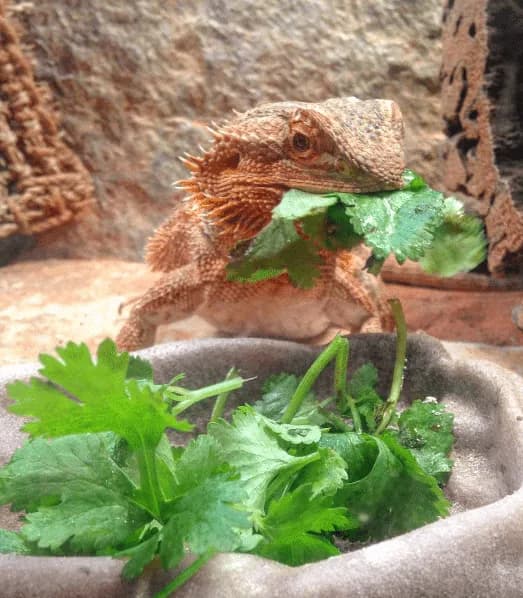
Greens
- Arugula/Rocket
- Bok choy
- Cactus pads
- Collard greens/Spring greens
- Endive/Chicory
- Escarole
- Kale
- Mustard greens
- Mustard cress
- Pea shoots
- Spring mix
- Turnip greens
- Watercress
Vegetables/Occasional Mixers
- Artichoke heart
- Asparagus
- Basil
- Beet leaves
- Bell pepper
- Carnations
- Cilantro
- Carrot greens
- Cucumber, peeled
- Carrot, grated raw
- Clover (pesticide- and herbicide-free)
- Dandelion greens/flowers
- Fennel
- Lemon balm
- Lemongrass
- Mint leaves
- Nasturtium
- Pansies
- Parsley
- Radicchio
- Rosemary
- Rose petals
- Spinach
- Squash, raw
- Sugar snap peas
- Swiss chard
- Thyme
- Yam, grated raw
- Zucchini
Fruits (to be used in small quantities as rare treats only)
- Banana
- Cactus fruit
- Mango
- Melon
- Berries
- Grapes
- Figs
- Papaya
- Peaches
- Apples
For more information on bearded dragon care from a reptile husbandry expert, read the ReptiFiles Bearded Dragon Care Manual!