Species Library
Spotted Python
Antaresia maculosa
Spotted Python Care Sheet
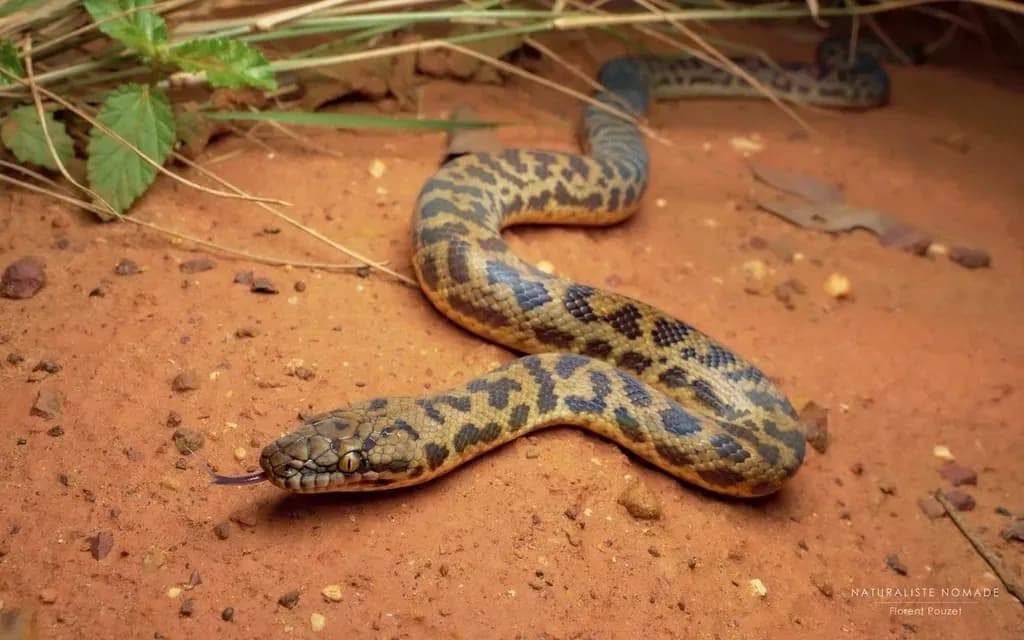
Welcome to the ReptiFiles Spotted Python Care Sheet! This care sheet was written by a professional reptile husbandry researcher, compiled based on reputable sources such as scientific research papers, natural history data, and the experiences of longtime keepers and breeders of this species. You can find a list of these sources at the bottom of this page.
What is a spotted python?
Spotted pythons are small, semi-arboreal, nocturnal snakes native to Australia. They are restricted to Australia’s fertile northeastern coast, as well as some nearby islands. These pythons occupy a diversity of habitats within this area, including open forest, sclerophyll forest, grasslands, rainforest fringes, and even agricultural areas. Spotted pythons particularly favor rock outcrops and caves, but they are also inhabit hollow logs, abandoned burrows, termite mounds, and leaf litter. It is not unusual to see a spotted python up off the ground in a shrub or tree.
Spotted pythons have a narrow head, with large shield scales, shallow labial heat pits, vertical pupils, a moderately robust body, and a relatively short tail. They feature a typically high-contrast pattern of darker brown blotches on a pale to medium brown background, and may demonstrate iridescence in the right light. The blotches are irregularly-shaped with ragged edges, sometimes running together along the spine to form a wavy or zigzag stripe. A dark streak runs through each eye. The python’s belly is lighter in color (yellowish to almost-white) and absent of pattern.
Spotted pythons are the largest members of Antaresia, but they’re still quite small, averaging around 3′ / 93cm long, with females being slightly larger than males. Northern (Cape York Peninsula) locality spotted pythons are noted as being generally larger than those from the southern half of their range, with the potential to grow as long as 5′ / 1.52m and 1000g (Mutton). However, spotted pythons may be capable of growing much larger in captivity — one account (Barker & Barker, 1994) reports an individual 69″ / 1.75cm long!
Considering their small size, relatively slow movement, hardiness, and largely docile dispositions, spotted pythons make excellent pet snakes even for beginners. Some even consider them to be the “easiest python to keep in captivity” (Julander et al., p.127). With attention to providing excellent spotted python care, this pet may live up to 30 years (Fyfe & Green, p.1).
Supplies You Need for a Pet Spotted Python
These are products I recommend for setting up a functional, high-welfare spotted python enclosure. The recommendations below apply to established juveniles and most adults 36″ / 90cm long and shorter. Some of the links in this care sheet are paid links — if you want to know why ReptiFiles uses paid links, visit this page.
- 36”L x 18”W x 18”H front-opening enclosure (preferably larger)
- 5.5″ Zoo Med Mini Deep Dome lamp fixture, x2
- 50w Exo Terra Intense Basking Spot bulb, x2
- Vivarium Electronics Rheostat (for brumation)
- Light-colored flagstone or concrete paver
- Heat mat, small enough to fit warm hide
- Herpstat 2 thermostat
- Etekcity 774 infrared thermometer
- Zoo Med Digital Combo Thermometer Humidity Gauge
- 22″ Arcadia T5 HO Forest 6% UVB kit
- 22″ Arcadia JungleDawn LED Bar
- Exo Terra Mister
- Zilla 24/7 Digital Power Center
- Zoo Med Aspen Snake Bedding, 32 qt
- Black box snake hide, x2 (small enough to provide a tight squeeze)
- Small sky hide
- Sturdy climbing branch, at least 1
- Environmental enrichment items
- Small water bowl
- Repashy Calcium Plus
- 12″ feeding tongs
- F10SC RTU veterinary disinfectant
Recommended Enclosure Size for Spotted Pythons
It is best practice to house a snake in an enclosure that is no shorter than the snake itself, allowing it adequate space to stretch out to its full length as needed/desired. The enclosure should be wide/deep enough for it to be able to turn around easily and accommodate appropriate furniture and decor. It must also be tall enough for the safe use of heat lamps and UVA+UVB lighting.
Many spotted pythons in the pet trade generally top out around 3’/91cm long, so the enclosure should be no smaller than 36″L x 18″W x 18″H / 90x45x45cm or equivalent. However, in the event that you have a large individual, you will need something proportionately larger. Males are also notably more active than females, so if you have a male spotted python, consider using an enclosure well beyond its body length.
One reliable method of estimating a young snake’s adult size is to ask the breeder about its parents! In sexually dimorphic species, females will usually grow up like their mother, and males like their father.
ReptiFiles recommends the following enclosures for housing spotted pythons long-term:
≤3′ long:
- Kages 36″x24″x18″ Premium PVC Reptile Enclosure with mesh top
- Toad Ranch SF36 3’x3’x19″ Luxury Reptile Enclosure
- Repti Zoo 36″x18″x18″ Easy Folding Tempered Glass Reptile Terrarium
≤4′ long:
- Reptile Habitats 4x2x2 (120 Gallon) Reptile Enclosure V3
- Zen Habitats 4x2x2 Reptile Enclosure 3.0
- Toad Ranch 4’x2’x2′ Luxury Reptile Cage
- Kages 4x2x2 PVC Reptile Enclosure — with 2 18″ screens
≤5′ long:
Of course, using a larger enclosure than the minimum is strongly recommended. Bigger is always better, as long as the space is set up well! All of the abovementioned brands also offer larger sizes.
Warning: Whichever enclosure you choose, make sure it’s EXTREMELY well-proofed against escape! Young spotted pythons are very small, and readily escape from their enclosure (and can be very difficult to find). Front-opening enclosures with very tight seams and swinging doors tend to be the most secure.
Can multiple spotted pythons be housed together?
Spotted pythons are not known to be significantly social animals, so it’s best to house only one per enclosure.
Lighting & UVB for Spotted Pythons
Spotted pythons are nocturnal, which means that they are most active around nighttime. They are capable of surviving without UVB light, but it’s important to remember that they can’t thrive without it. UVB helps regulate their day/night cycle and associated hormonal rhythms, as well as provides all of the vitamin D3 they can possibly need, supporting all associated physiological processes.
Lighting should be on for 12 hours/day. Alternatively, you can use a smart timer like Kasa to sync the lamps with your local sunrise/sunset times
UVB Lighting
UVB lighting can be tricky, because in order to get the right strength of UVB (UV Index, or UVI), distance and potential mesh obstruction must be considered. To provide appropriate UVB, you will need a high-quality, low-intensity UVB bulb, long enough to fully cover the snake’s body when basking. This lamp must be placed on the warm side of the setup, overlapping with the heat lamp(s) for maximum effectiveness.
Here is a general reference for effective basking distance, measured from the UVB bulb to the snake’s back on its basking surface:
- Arcadia ShadeDweller 7% kit
- mesh: 6-8” / 15-20cm
- no mesh: 9-10” / 23-25cm
- Arcadia T5 HO Forest 6% / Zoo Med T5 HO Reptisun 5.0
- mesh: 10-13” / 25-33cm
- no mesh: 14-17” / 35-43cm
Use an Arcadia, Vivarium Electronics, or equivalent fixture to optimize output and make the most of your lamp. The Zoo Med hood is not recommended, as it is not very efficient.
Although high-quality, the above UVB bulbs must be replaced every 12 months to maintain consistent output, even if they are still producing visible light!
(These recommendations are approximations based on available data, assuming a 35% mesh block. For best results, use a Solarmeter 6.5 to determine the best placement to achieve a UVI of 2.0-3.0 in the basking area.)
Heating Requirements for Spotted Pythons
Humans are warm-blooded, which means that our body temperature is automatically regulated. Spotted pythons, however, are cold-blooded (poikilothermic), which means that they have to move between areas of different temperatures in order to regulate their body temperature. In captivity, incandescent heat bulbs are the best way to replicate the type of warmth provided by sunlight.
- Basking surface: ~90°F (32°C)
- Warm hide: 90°F (32°C)
- Cool zone (ambient): 78-84°F (26-29°C)
Heating should be turned off at night. Temperatures can safely fall to 68°F/20°C. However, if the room gets cooler than this, use a low-wattage heat projector or radiant heat panel (connected to a dimming thermostat) to provide supplementary warmth at night.
To measure the temperatures in your enclosure, use an infrared thermometer (a.k.a. temperature gun). To passively track the temperatures in your enclosure, use a digital probe thermometer or two. The Etekcity 774 is a good infrared thermometer, and most reptile-brand digital probe thermometers function well.
How to create the basking spot:
Although spotted pythons are nocturnal, it’s still important to give them the option of basking under an incandescent heat lamp. Incandescent heat lamps produce sun-like Near-Infrared wavelengths (IR-A & IR-B) for efficient thermoregulation in reptiles.
The best reptile heat lamp on the market is the Reptile Systems Gold Infrared Unit, as this lamp produces the most IR-A with a generous and even spread for your snake to benefit from. 50-100w should hit the right temperatures for a spotted python, depending on basking distance. (Here’s some helpful charts to help you choose.)
Generally speaking, 50-75w incandescent basking spot bulbs (I prefer the Exo Terra Intense Basking Spot and ReptiZoo Intense Basking Spot) should be plenty to achieve your target basking surface temperature. Place a flat, light-colored stone on top of a black plastic hide box, which will act as your warm hide. If you notice that the stone is getting too hot, use a lower wattage bulb. If too cool, you need higher wattage instead.
It’s best practice to use multiple heat bulbs to create a large enough basking area to evenly heat your snake’s coiled body. Two bulbs should be enough for an average adult spotted python.
How to create the warm hide:
As nocturnal ambush hunters, wild spotted pythons get most of their heat energy from the ambient warmth (IR-C) of the burrows, logs, and rock crevices that they like to sleep in. A warm hide is designed to replicate this environment so your snake isn’t forced to choose warmth over security.
Place a heat mat between the basking stone and the black box hide, and connect that heat mat to a pulse (on/off) thermostat like Inkbird, set to 90°F / 32°C. The thermostat probe should go inside the warm hide to regulate its temperature. Make sure to check your warm hide temps regularly with your temp gun.
Winter Cooling/Brumation:
It is best practice to brumate spotted pythons through the winter, as this is something they do in the wild, but it’s more than just a way to survive low temperatures and scarce food. This process helps regulate their hormonal rhythm, which is essential for successful breeding (in other words, good health).
There are different methods of brumating a spotted python, but one of the simplest approaches is to gradually reduce the basking window. This should be done with a lamp dimmer(s) to gradually reduce the heat in late fall and then gradually bring it back up again in early spring.
DO NOT BRUMATE A SICK OR UNDERWEIGHT REPTILE. If your snake seems to be losing a significant amount of weight or otherwise unhealthy during brumation, see a vet immediately.
Humidity Requirements for Spotted Pythons
Spotted pythons are not very picky when it comes to humidity, and they have been kept successfully at ambient humidities between 20% and 80%. This is partly because successful shedding in Antaresia is more temperature-dependent than humidity-dependent. Make sure your spotted python has consistent access to a humid hide and ambient humidity levels are generally between 20-80%, and you should have nothing to worry about.
To measure humidity levels, use a digital probe hygrometer with the probe on the substrate in the middle of the enclosure. Humidity levels that are consistently higher than this range may make your pet unwell, although it is normal for humidity to be higher on the cool end and lower on the warm end, as well as higher at night.
To create a humid hide, place a hide box on the cool half of the enclosure with lightly moistened substrate or sphagnum moss inside. It’s also beneficial to occasionally mist the enclosure with a water sprayer, especially in the early morning to simulate dew.
Substrate Options for Spotted Pythons
Spotted pythons are going to be healthiest and happiest when they are housed on a substrate (a.k.a. “bedding”) that imitates the conditions of their natural habitat and facilitates appropriate humidity levels. Given that they’re not very picky about humidity and live in a variety of habitats, there are many different substrates that can work for this species. However, loose substrates are going to be best, as these snakes do like to hide under their bedding when they can.
Here are some good picks for spotted python substrate:
- Aspen snake bedding
- Reptichip Babichip
- Play sand
- DIY semi-arid mix: 40% plain topsoil + 40% play sand + 20% Zoo Med Excavator Clay, measured by weight
2-3″ / 5-8cm of substrate should be plenty, depending on the size of the snake. In a 36x18x18 enclosure, this takes approximately 0.75-1.1 cubic feet of material, or 23-34 quarts.
Solid substrates such as paper towel or terrarium mats should be avoided unless the snake is in quarantine.
Decorating the Enclosure (Environmental Enrichment)
Decorations play an essential role in your spotted python’s enclosure as environmental enrichment. Enrichment items encourage exercise, stimulate more interesting behaviors from your pet, and help promote overall wellbeing. And, of course, they make the enclosure look nice!
Spotted pythons favor rock outcrops, caves, and fallen timber, and they’re also enthusiastic climbers. Juvenile spotted pythons in particular favor elevated hiding spots (“sky hides”) over hiding on the ground. Keep these features in mind as you set up the enclosure’s “furniture”.
Décor ideas: additional hideouts/caves, flagstone*, cork logs, cork flats, cholla wood, ghostwood branches, Magnaturals ledges, artificial plants, drought-tolerant live plants
If you want to make a rock stack in your enclosure, make sure to anchor it to the bottom of the enclosure and reinforce it against shifting, which can potentially crush your pet! Gorilla Glue works well for sticking stones together in a terrarium. However, make sure to keep the interior of the stack accessible in case you need to get your snake out of there in a hurry.
If you want to use live plants in your spotted python enclosure, you’ll want hardy plants that don’t need too much water and are sturdy enough to survive the snake’s activities. Good options include snake plant, pothos, ponytail palm, spider plant, and ZZ plant.
For ideas on how to set up and decorate your spotted python enclosure, I recommend scrolling through photos of spotted pythons in their natural habitat on iNaturalist!
Feeding Your Spotted Python
Spotted pythons are carnivores, which means that they need a diet of whole animal prey in order to get the nutrition that their bodies need. Juveniles should be fed every 7-10 days, and adults should be fed every 10-21 days, depending on the size of the previous meal. At each feeding, provide prey which totals around 10% of your snake’s weight, or 1-1.5x the snake’s width at its widest point.
Reference photos of healthy wild spotted pythons to check your pet’s body condition. If the snake appears to be getting too fat, use smaller feeders. If too thin, offer food more often.
Although mice are the most common feeders, the key to providing a healthy, balanced diet for your pet snake is VARIETY. In the wild, spotted pythons have a varied diet of lizards, smaller snakes, frogs, rodents, bats, and small birds. Juveniles are particularly fond of lizard and frog prey.
Prey item ideas: mice, young rats, young hamsters, young gerbils, young quail, chicken chicks, green anoles, mourning geckos, crested geckos, Pictus geckos, Reptilinks
It’s best to offer frozen-thawed prey rather than live to your pet snake. This is safer for the snake and generally considered to be more humane as well. Prey should be thawed in a plastic bag in warm water to 90-100°F/32-38°C before offering. Use soft-tipped feeding tweezers to reduce the risk of getting accidentally bitten when the snake strikes, as spotted pythons are quite enthusiastic about food!
Supplements
Spotted pythons can survive without vitamin or mineral supplements, but using them occasionally is a good way to help prevent nutritional deficiencies. Every 4-6 feeds, lightly dust the prey item with a 50/50 mix of calcium and multivitamin before thawing.
Arcadia RevitaliseD3 and Repashy Calcium Plus are both good supplements to use.
Water
Your spotted python should have free access to a small bowl of fresh, clean water daily. The bowl should be scrubbed out with veterinary disinfectant such as Rescue or F10SC weekly for good hygiene.
Handling Your Spotted Python
You will need to wait a little while after bringing your new pet home to let it settle in. This usually takes about 2 weeks, but you shouldn’t start handling until it’s eating regularly.
Once your spotted python is ready for handling, take it slow at first — just like any relationship. Baby spotted pythons are more defensive than the adults, and may take longer to calm down. Some may rear and strike, while others may prefer to hide their head within their coils.
Start with brief handling sessions (no longer than 5 minutes), and don’t return the snake until it is calm. This teaches your pet how to behave during handling by using rudimentary positive reinforcement. Once this has been accomplished, you can work up to longer sessions. Handling should occur at least weekly if you want your pet to be hand-tame, but no more than once daily.
While handling your snake, be gentle. Rather than grabbing it, let it crawl onto your hand. Lift it from below rather than above, and support as much of its body as possible. Use slow movements and don’t walk around too much. Stimson’s pythons usually tolerate handling well and very rarely bite.
For excellent advice on choice-based handling techniques from a professional, visit Lori Torrini on YouTube.
Hygiene
Quarantine
If you have other reptiles in your home, it’s important to place your new spotted python in a basic quarantine setup for up to 6 weeks, away from contact with your other pets. During this time, take your new pet to an experienced reptile vet for an initial checkup, do any relevant testing for disease or parasites, and generally monitor their health.
It’s much easier to keep track of a reptile’s health in a quarantine setup than a fully-enriched habitat. For information on how to quarantine new reptiles, see this article and video: How to Quarantine Reptiles.
Keeping the Enclosure Clean
Feces and urates should be removed immediately, and contaminated substrate should be scooped out and replaced. Substrate should be completely replaced once every 3-6 months, depending on how diligent you are about spot-cleaning.
If water spots accumulate on the glass, use white vinegar and a paper towel to remove them. Rinse afterward to remove remaining residue and odor. If the odor of white vinegar bothers you, you can use lemon juice instead — although you will have to do a bit more scrubbing.
Every 6-12 months, do a complete cleanout of the enclosure. Remove all substrate and decor. Give the decor a good scrub with hot water. Wash the walls and floor, then follow with veterinary-grade disinfectant (Rescue, F10SC, or 10% bleach solution). Use the disinfectant according to the directions on the label, paying special attention to contact time and rinse requirements.
Snakes are particularly sensitive to scents, so having their scent suddenly removed from their enclosure during cleaning can be stressful. Scattering some of the old (but clean) substrate around the setup and inside the hides can help your snake feel more comfortable.
Handling Hygiene
Wash your hands, put on a new pair of disposable gloves, or at least put on some alcohol-based hand sanitizer before handling the snake.
Never eat or put anything else in your mouth during handling.
After handling the snake or performing maintenance on the enclosure, make sure to scrub your hands thoroughly with soap and water. If that isn’t possible, apply a generous amount of alcohol-based hand sanitizer.
If you were handling a snake of unknown health, remove and wash your clothes before coming into contact with your own reptiles, in addition to washing your hands.
References
Antaresia Species Caresheet (Stimson’s, Children’s, Spotted and Pygmy Pythons). (n.d.). The Unusual Pet Vets. Retrieved June 10, 2022, from https://www.unusualpetvets.com.au/wp-content/uploads/2018/05/Antaresia-Stimsons-Childrens-Spotted-and-Pygmy-Python-Care-Sheet.pdf
Barker D., & Barker, T. (1994). Pythons of the World (Volume I, Australia). AVS Books, Escondido, California.
Cogger, H. (2018). Reptiles and Amphibians of Australia (7th ed., p. 815-816). Csiro Publishing.
Fyfe, G., & Green, D. (2003). Keeping Children’s Pythons. Australian Reptile Keeper Publications.
Julander, J., Mutton, N., & Birch, P. (2013). The Complete Children’s Python: A Comprehensive Guide to the Natural History, Care, and Breeding of Antaresia Species (p. 27-48, 127–146). ECO Herpetological Publishing.
Low UV Species. (n.d.). Arcadia Reptile. Retrieved March 5, 2026, from https://arcadiareptile.com/lighting/low-uv-species/
Mutton, N. (n.d.). Antaresia maculosa. Inland Reptile. Retrieved May 9, 2026, from https://www.inlandreptile.com/maculosa/antaresia%20maculosa.htm
Swanson, S. (2007). Field Guide to Australian Reptiles (3rd ed., p. 323). Steve Parish.
Wilson, S., & Swan, G. (2021). A Complete Guide to Reptiles of Australia (6th ed., p. 546-547). New Holland Publishers Pty, Limited.