Species Library
Northern Emerald Tree Boa
Corallus caninus
Northern Emerald Tree Boa Care Sheet
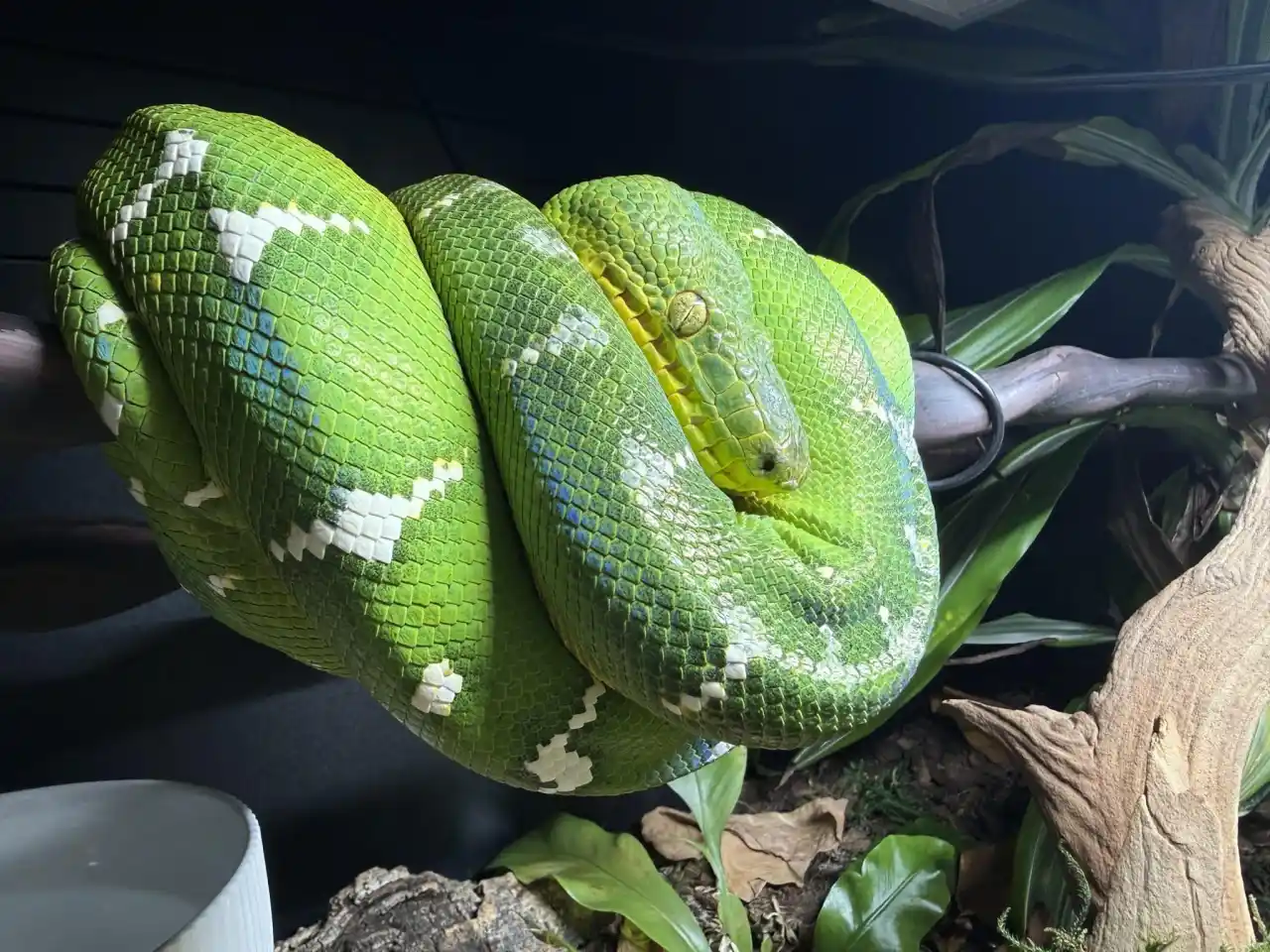
Welcome to the ReptiFiles Northern Emerald Tree Boa Care Sheet! This care sheet was written by a professional reptile husbandry researcher, compiled based on reputable sources such as scientific research papers, natural history data, and the experiences of longtime keepers and breeders of this species. You can find a list of these sources at the bottom of this page.
Special thanks to Zion McAndrews of EmeraldTreeBoas.org for collaborating with me on this guide. For more thorough information on caring for this species, visit his site!
What is a Northern Emerald Tree Boa?
Northern emerald tree boas are medium-sized (5-6′ / 1.5-1.8m), arboreal, nocturnal snakes native to the Guiana Shield region of northern South America. They can be found in Brazil, French Guiana, Guyana, Suriname, and Venezuela. They occupy primary and secondary rainforest, where they spend almost their entire lives in the trees, often (but not always) positioned over bodies of water.
Northern emerald tree boas have a large, pear-shaped head, strongly visible heat pits along their lips, oversized recurved teeth, vertical pupils, moderate but highly muscular build, and a prehensile tail. True to their name, adults are typically characterized by a vibrant green base color with a pattern of paired white triangular or line-like markings along their back. Some individuals also have darker stippling around the white markings and on the head. The lips are usually yellow, but they can be light green or both colors. The underside ranges from white to yellow in color, and is usually patternless. Eyes are typically silver to pale golden in color.
Emerald tree boas undergo ontogenetic color change as they mature. Babies are typically red-orange with white markings before the shift to green, likely as better camouflage for a lifestyle closer to the forest floor.
Emerald tree boas demonstrate sexual dimorphism, with females being longer and heavier-bodied, and males being smaller and more slender. Large northern females have been known to exceed 6.5′ / 2m long in captivity.
With proper Northern emerald tree boa care, this pet may live longer than 25 years.
Supplies You Need for a Northern Emerald Tree Boa
These are products I personally recommend for setting up a functional emerald tree boa enclosure. Some of the links in this care sheet are paid links — if you’d like to know why ReptiFiles uses paid links, visit this page.
- 6’L x 2’W x 4’H front-opening enclosure, preferably larger
- Reptile Systems Gold Infrared Unit, 200w
- Herpstat 1 thermostat
- Arcadia ShadeDweller 7% UVB kit
- 22″ Arcadia JungleDawn LED Bar, x2
- Zilla 24/7 Digital Power Center
- MistKing Starter
- extra MistKing nozzles, x6
- Reptichip substrate, 120 quarts
- 6′ long perches, at least 3
- Live or artificial foliage (preferably live)
- Zoo Med Digital Combo Thermometer Humidity Gauge, x2
- Large water tub
- Repashy Calcium Plus LoD
- 12″ soft-tipped feeding tongs
- F10SC RTU veterinary disinfectant
Recommended Enclosure Size for Northern Emerald Tree Boas
It is best practice to house an arboreal snake in an enclosure that is no shorter than the snake itself, allowing it adequate space to stretch out to its full length as needed/desired. The enclosure should be wide/deep enough for it to be able to turn around easily and accommodate appropriate furniture and decor, without becoming difficult to maintain. It must also be tall enough for vertical thermoregulation and hygroregulation behaviors without forcing the animal to go to the ground.
Adult northern emerald tree boas are generally around 5-6’/1.5-1.8m long, so a good minimum enclosure size to start with is 6’L x 2’W x 4’H / 1.8 x 0.6 x 1.2m or equivalent, as this will comfortably accommodate most individuals.
Due to emerald tree boas’ humidity needs, if you live in a dry climate, it’s likely to be best to use a solid-top enclosure with plenty of vents. This should be no less than a series of vents on the top of the warm side wall and another set of vents along the bottom of the cool side wall (above substrate dam level).
ReptiFiles recommends the following enclosures for northern emerald tree boas:
- Toad Ranch 6’x2’x4′ Luxury Reptile Cage
- Kages Custom Reptile Enclosure
- Tamura Designs Custom Reptile Enclosure
Of course, using a larger enclosure than the minimum is strongly recommended, especially taller in this case. Bigger is always better, as long as the space is set up well! All of the abovementioned brands offer larger sizes.
Because you will need such a large enclosure, it’s most cost-effective to build your own enclosure rather than buy one, if you’re willing. The DIY Reptile & Amphibian Enclosures group on Facebook is a good place to get tips on how to do this.
*Once established, young emerald tree boas can be housed in an adult-sized enclosure with no problems as long as they have enough places to hide and feel secure.*
Can multiple northern emerald tree boas be housed together?
Northern emerald tree boas are not known to be significantly social animals, so it’s best to house only one per enclosure.
Lighting & UVB Requirements for Northern Emerald Tree Boas
Emerald tree boas are nocturnal, which means that they are most active around nighttime. They are capable of surviving without UVB light, but it’s important to remember that they can’t thrive without it. UVB helps regulate their day/night cycle and associated hormonal rhythms, as well as provides all of the vitamin D3 they can possibly need, supporting all associated physiological processes.
Lighting should be on for 12 hours/day. Alternatively, you can use a smart timer like Kasa to sync the lamps with your local sunrise/sunset times
UVB Lighting
UVB lighting can be tricky, because in order to get the right strength of UVB (UV Index, or UVI), distance and potential mesh obstruction must be considered. To provide appropriate UVB, you will need a high-quality, low-intensity UVB bulb, long enough to fully cover the snake’s body when basking. This lamp must be placed on the warm side of the setup, overlapping with the heat lamp(s) for maximum effectiveness.
Here is a general reference for effective basking distance, measured from the UVB bulb to the snake’s back on its basking surface:
- 22″ Arcadia ShadeDweller 7% kit
- mesh: 7-9” / 18-23cm
- no mesh: 9-11” / 23-28cm
- 22″ Arcadia T5 HO Forest 6% / Zoo Med T5 HO Reptisun 5.0
- mesh: 12-16” / 30-40cm
- no mesh: 14-18” / 35-45cm
Use an Arcadia, Vivarium Electronics, or equivalent fixture to optimize output and make the most of your lamp. The Zoo Med hood is not recommended, as it is not very efficient.
Although high-quality, the above UVB bulbs must be replaced every 12 months to maintain consistent output, even if they are still producing visible light!
(These recommendations are approximations based on available data, assuming a 20-25% mesh block. For best results, use a Solarmeter 6.5 to determine the best placement to achieve a UVI of 2.0-3.0 in the basking area.)
Heating Requirements for Northern Emerald Tree Boas
Humans are warm-blooded, which means that our body temperature is automatically regulated. Emerald tree boas, however, are cold-blooded (poikilothermic), which means that they have to move between areas of different temperatures in order to regulate their body temperature. In captivity, incandescent heat bulbs are the best way to replicate the type of warmth provided by sunlight.
Temperature gradient for northern emerald tree boas:
- Basking area: 85-90°F (29-32°C)
- General ambient: 75-82°F (24-28°C)
- Cool zone (shade): 72-75°F (22-24°C)
- Nighttime: 72-75°F (22-24°C)
Heat lamps should be turned off at night. However, if your room temperature is <72°F/22°C, then you will need a lightless heat source for nighttime. For a large enclosure, a large radiant heat panel connected to a dimming thermostat does the job well. The thermostat probe should be placed below the heat panel on a branch at middle height.
To measure the temperatures in your enclosure, use an infrared thermometer, or temperature gun. To passively track the temperatures in your enclosure, use digital probe thermometers with the probes securely anchored in the areas you need to track (basking branch, middle zone, shade). The Etekcity 774 is a good infrared thermometer, and most reptile-brand digital probe thermometers function well.
How to create the basking spot:
Although emerald tree boas are nocturnal, it’s still important to give them the option of basking under an incandescent heat lamp in a made-made “sunbeam”. Incandescent heat lamps produce sun-like Near-Infrared wavelengths (IR-A & IR-B) for efficient thermoregulation in reptiles.
The best reptile heat lamp on the market is the Reptile Systems Gold Infrared Unit, as this lamp produces the most IR-A with a generous and even spread for your snake to benefit from. 100-200w should hit the right temperatures for a northern emerald tree boa, depending on basking distance. (Here’s some helpful charts to help you choose.)
If the Gold Infrared isn’t an option, you can also use a cluster of incandescent basking spot bulbs (not halogen). I prefer the Exo Terra Intense Basking Spot and ReptiZoo Intense Basking Spot for the widest and most even spread of heat. It’s best practice to use multiple heat bulbs to create a large enough basking area to evenly heat your snake’s coiled body, as well as help warm the rest of the enclosure. I recommend at least 4 bulbs for a full-sized emerald tree boa enclosure.
Optimal bulb wattage depends on various factors, including basking distance and room temperature, but 75w should be a good starting point. If you notice that the basking area is getting too hot, use a lower wattage bulb. If too cool, you need higher wattage instead.
Humidity Requirements for Northern Emerald Tree Boas
Emerald tree boas are tropical reptiles, and sensitive to dehydration, but that doesn’t mean that they should be kept sopping wet. In fact, keeping them too wet can be just as bad as keeping them too dry! The key is to keep their enclosure humid but well-ventilated enough that is is capable of drying out between mistings.
Northern emerald tree boas do best with humidity levels between 75-90%. This species doesn’t tolerate inconsistent humidity well, so this is an aspect of your pet’s care that you will really need to stay on top of. Inconsistent humidity can lead to health problems like dehydration, stuck shed, respiratory infections, and general stress.
Ambient humidity should be tracked via at least two digital probe hygrometers, with the probes placed at different levels of the setup.
How to humidify your emerald tree boa enclosure:
To maintain the humidity in your snake’s enclosure, it’s best to use an automatic misting system like Mistking. You will need at least 8 nozzles for a 6’x2′ enclosure. The system should be programmed to mist frequently but for short periods of time so you don’t flood the enclosure. The snake itself should NOT be kept wet. Make sure to use reverse osmosis or distilled water to avoid clogging the nozzles.
Aside from using an automatic misting system, it helps to use a deep, moisture-retentive substrate and a large tub of water on the warm side of the enclosure.
Ventilation
Too much humidity and too little airflow creates a stagnant environment that can make your boa sick. Aside from using a generously-vented enclosure, it’s best to install a 4″ fan on the cool side of the enclosure to keep the air moving.
Substrate Options for Northern Emerald Tree Boas
Emerald tree boas are likely to be healthiest and happiest when they are housed on a substrate (a.k.a. “bedding”) that imitates the conditions of their natural habitat and supports a higher humidity environment. Options for substrate include:
- DIY tropical mix: 40% plain topsoil + 40% coconut fiber + 20% play sand (by weight)
- Zoo Med Eco Earth
- Exo Terra Plantation Soil
- Reptichip
Provide a substrate layer that is at least 4” deep. This takes about 4 cubic ft or 120 quarts of substrate to achieve in an 6′x2′ enclosure. A generous layer of clean leaf litter on top is recommended.
Bioactive can be a great way to reduce enclosure maintenance and better maintain stable humidity levels. However, it’s not magic, and bioactive setups come with their own challenges and specific maintenance. You will also need more substrate to support large live plants: at least 8″/20cm. Good bioactive-ready substrate mixes include the Bio Dude Terra Fauna bioactive kit, Josh’s Frogs BioBedding Tropical, and Galapagos Bioactive Soil – Tropical. For essential information and tips on bioactive reptile keeping, see my articles on the subject.
Décor (Environmental Enrichment) for Northern Emerald Tree Boas
Decorations play an important role in your boa’s enclosure as environmental enrichment. These items are not optional — they are essential to promoting positive welfare for your pet! Enrichment items encourage exercise, stimulate the snake’s natural instincts, and help stave off boredom.
- sturdy branches/perches
- large live plants
- Pothos
- Heartleaf Philodendron
- Calathea
- Alocasia
- Bromeliads
- Spanish moss
- Sheet/cushion moss
- Passionflower vines
- Dracaena
- Ficus
- Schefflera
- sturdy artificial plants
- ceiling- and side-mounted hide boxes
At minimum, you will need branches for perching and foliage for cover. However, I encourage you to go well beyond the minimum to maximize the amount of usable space in your pet’s home.
Live plants can be very helpful for helping with humidity and holding on to water droplets for drinking, but make sure they’ll be large enough to withstand your snake’s activities. Avoid placing them directly underneath heat sources, and make sure any mounted plants are well-secured.
Perches/Branches
Perches are extremely important in an emerald tree boa enclosure, and not just any horizontal branch will do. These branches need to be sturdy but small in diameter so the snake can grip them properly. Perches can be rigid natural branches, custom-made, or DIY-ed from textured or wrapped PVC pipe.
All branches should be firmly secured to the walls or floor of the enclosure to prevent them from falling and potentially injuring your snake. However, it’s also best to make these branches removable as well so you don’t have to fight your snake if you need to take it out.
Here are some reputable brands for ready-made and custom snake perches: Reptile Perch, Snakescapes
Feeding Your Northern Emerald Tree Boa
Emerald tree boas are carnivores, which means that they need a diet of whole animal prey in order to get the nutrition that their bodies need. Juveniles should be fed every 7-10 days, subadults can be fed every 10-20 days, and adults should be fed every 2-4 weeks. At each feeding, provide prey which totals around 10% of your snake’s weight, or 1-1.5x the snake’s width at its widest point.
Reference photos of healthy wild emerald tree boas to check your pet’s body condition. If the snake appears to be getting too fat, use smaller feeders. If too thin, offer food more often. A northern emerald tree boa should look noticeably muscular.
Although mice and rats are the most common feeders for snakes, the key to providing a healthy, balanced diet for your pet is VARIETY. In the wild, adult northern emerald tree boas have a varied diet of rodents, bats, and other small mammals. Juveniles also eat lizards and snakes. Birds are notably absent from wild data, but that doesn’t mean a pet emerald tree boa is unlikely to accept one if offered.
Prey item ideas: mice, rats, hamsters, gerbils, quail, chicken chicks, green anoles, Reptilinks
It’s best to offer frozen-thawed prey rather than live to your pet snake. This is safer for the snake and generally considered to be more humane as well. Prey should be thawed in a plastic bag in warm water to 90-100°F/32-38°C before offering. Use soft-tipped feeding tweezers to reduce the risk of getting accidentally bitten when the snake strikes.
Supplements
Emerald tree boas can survive without vitamin or mineral supplements, but using them occasionally is a good way to help prevent nutritional deficiencies. Every once in a while, lightly dust the prey item with a 50/50 mix of calcium and multivitamin before thawing.
Zoo Med Repti Calcium+Reptivite and Repashy Calcium Plus are both good supplements to use for this purpose.
Water
Your emerald tree boa should have free access to a large bowl of fresh, clean water daily. Although these boas often drink water droplets accumulated on foliage (particularly live foliage) from routine misting, if you are concerned about your snake’s water intake, a large wall-mounted water dish can be appropriate.
Handling Your Northern Emerald Tree Boa
Handling is an essential part of owning a pet snake. Although emerald tree boas are generally best suited to life as a minimally-handled display animal rather than a frequently-handled companion, getting your pet accustomed to handling makes tasks such as taking it to the vet and cleaning its enclosure a lot easier.
Are northern emerald tree boas aggressive?
Emerald tree boas have a reputation for being “bitey” or “unhandleable,” but respectful, gentle handling and sourcing your pet from a verified breeder can result in a calm, confident adult. Note, however, that it is still normal for juveniles to be nervous and defensive in the beginning.
Taming your emerald tree boa
ReptiFiles recommends choice-based reptile handling whenever possible. For excellent advice on choice-based handling techniques from a professional, visit Lori Torrini on YouTube.
Tips for successful handling
Before you get your snake out of its enclosure, wash your hands or at least apply hand sanitizer. Once your hands are clean and smell like chemicals, use a paper towel roll or snake hook to gently tap the snake on the head. This lets your pet know that it’s time for handling — not food — and prevents potential accidents caused by a misunderstanding. Once the snake shows calm, slow tongue flicks, it is safe to pick it up.
While handling your snake, be gentle. NEVER grab or pull an emerald tree boa off its perch! (This is why removable perches are strongly recommended for this species.) If you must get the snake off its perch, you can “tease” it off by using a finger to tickle/gently scratch the tail to loosen its grip. Lift it from below rather than above, and support as much of its body as possible. For adults, one hand should be behind the head, and another should support the rest of the body. Be especially careful with juvenile boas <1 year old, as their tails are extremely delicate and easily damaged.
Since snakes don’t have hands or feet to help them climb, they use their powerful muscles to wrap around objects for stability. During handling, your boa will treat you like a tree, wrapping around your body, arms, etc. so it doesn’t fall. Use your hands to guide its movement, and don’t let it wrap around your neck. Use slow movements and don’t walk around too much. Children should not be allowed to handle snakes alone.
Hygiene
Quarantine
If you have other reptiles in your home, it’s important to place your new emerald tree boa in a basic quarantine setup 3-6 months, away from contact with your other pets. During this time, take your new pet to an experienced reptile vet for an initial checkup, do any relevant testing for disease or parasites, and generally monitor their health.
It’s much easier to keep track of a reptile’s health in a quarantine setup than a fully-enriched habitat. For information on how to quarantine new reptiles, see this article and video: How to Quarantine Reptiles.
Keeping the Enclosure Clean
Feces and urates should be removed immediately, and contaminated substrate should be scooped out and replaced. 1x/month, fluff the substrate with a fork to introduce oxygen and slow pathogen growth. Substrate should be completely replaced once every 3-6 months, depending on how diligent you are about spot-cleaning and fluffing.
Make sure to change out the water 1x/week or whenever it gets soiled. Give the bowl a good scrub and wipedown with veterinary disinfectant before refilling.
If water spots accumulate on the glass, use white vinegar and a paper towel to remove them. Rinse afterward to remove remaining residue and odor. If the odor of white vinegar bothers you, you can use lemon juice instead — but you will have to do a bit more scrubbing.
Every 6-12 months, do a complete cleanout of the enclosure. Remove all substrate and decor. Give the decor a good scrub with hot water. Wash the walls and floor, then follow with veterinary-grade disinfectant (Rescue, F10SC, or 10% bleach solution). Use the disinfectant according to the directions on the label, paying special attention to contact time and rinse requirements.
Snakes are particularly sensitive to scents, so having their scent suddenly removed from their enclosure during cleaning can be stressful. Scattering some of the old (but clean) substrate around the setup and inside the hides can help your snake feel more comfortable.
Handling Hygiene
This removes weird scents, and removes potentially harmful bacteria, viruses, or parasites from your hands. If you are particularly smelly/have been spending a lot of time around other animals, it is also advisable to change clothes. I like to rub hand sanitizer on my hands as well to make sure I’m labeled by a consistent scent that is very different from food.
Never eat or put anything else in your mouth during handling. Similarly, resist the temptation to kiss your snake; they won’t feel less loved, and you’re less likely to get sick.
After handling the snake or performing maintenance on the enclosure, make sure to scrub your hands thoroughly with soap and water. If that isn’t possible, apply a generous amount of alcohol-based hand sanitizer.
If you were handling a snake of unknown health, remove and wash your clothes before coming into contact with your own reptiles, in addition to washing your hands.
References
Baines, F. M., Chattell, J., Dale, J., Garrick, D., Gill, I., Goetz, M., Skelton, T., & Swatman, M. (2016). How much UVB does my reptile need? The UV-Tool, a guide to the selection of UV lighting for reptiles and amphibians in captivity. Journal of Zoo and Aquarium Research, 1, 58. https://www.jzar.org/jzar/article/view/150/89
Henderson, R. W. (2015). Natural History of Neotropical Treeboas (genus Corallus). Edition Chimaira.
Low UV Species. (n.d.). Arcadia Reptile. Retrieved March 17, 2026, from https://www.arcadiareptile.com/lighting/low-uv-species/
McAndrews, Z. (n.d.). EmeraldTreeBoas.Org. Retrieved February 27, 2026, from https://www.emeraldtreeboas.org/
Paulette, D. (2008). Corallus caninus (Emerald Tree Boa) (T. Dewey, Ed.). Animal Diversity Web. https://animaldiversity.org/accounts/Corallus_caninus/
Volk, S. (2014, November 17). Expert Care For The Emerald Tree Boa. Reptiles Magazine. https://reptilesmagazine.com/expert-care-for-the-emerald-tree-boa/
The ReptiFiles Northern Emerald Tree Boa Care Sheet is a simplified care summary, not a full ReptiFiles care guide. While I have done my best to ensure that the information contained is accurate, due to time constraints, the research behind ReptiFiles care sheets is not as thorough as the research involved with my full-length care guides. I strongly encourage readers to do their own research from high-quality, reputable sources outside of just this care sheet as part of preparing for your new pet reptile.
For further reading, I strongly recommend visiting EmeraldTreeBoas.org.