From Biology to Technology Series: How Herptiles Are Shaping the Future of Innovation - Part 1
In an effort to disarm misconceptions, this paper highlights some unique herptile capabilities and their practical applications within science.
Galen McKenna
Educational Assistant - Herpetological Environments and Research in Practice (HERP) Laboratory, Eckerd College
- Nature's creation often far surpasses human technology
- Complex and ingenious features of animals can be utilized in human creation
- The wasp stinger is a great example of biomimetic application
- Herptile inclusion in biomimicry has been limited, until now, due to a lack of understanding of these animals
Biomimicry is the application of natural principles to human technology.
When it comes to innovation, nature has often been humanity’s greatest engineer.[8]Ersanli, E. T., & Ersanli, C. C. (2023). Biomimicry: Journey to the Future with the Power of Nature. International Scientific and Vocational Studies Journal, 7(2), 149–160. https://doi.org/10.47897/bilmes.1388402View source Across the broad spectrum of plant and animal life, every wing, scale, and leaf represents millions of years of evolutionary problem-solving. These adaptations have resulted in biological structures and characteristics often far surpassing human innovations, leaving engineers and scientists baffled as they try to recreate such feats.[14]Pathak, S. (2019). Biomimicry: (Innovation inspired by nature). International Journal of New Technology and Research, 5(6). https://doi.org/10.31871/ijntr.5.6.17View source
For example, take the stinger of a wasp and compare it to the likes of a medical needle. The stinger is only about 1/10 of a millimeter wide, composed of interlocking microscopic components that can both move independently and coordinate with each other.[5]Das, R., Yadav, R. N., Sihota, P., Uniyal, P., Kumar, N., & Bhushan, B. (2018). Biomechanical evaluation of wasp and honeybee stingers. Scientific Reports, 8(1), 14945. https://doi.org/10.1038/s41598-018-33386-yView source Each part slides past the other like rails, allowing penetration with minimal force at an incredibly precise level.[18]Zhao, Z., Zhao, H., Ma, G., Wu, C., Yang, K., & Feng, X. (2015). Structures, properties, and functions of the stings of honey bees and paper wasps: a comparative study. Biology Open, 4(7), 921–928. https://doi.org/10.1242/bio.012195View source In comparison, even the thinnest human medical needles are multitudes thicker than the stinger and cannot achieve the same fine and flexible motion.[9]Fung-A-Jou, Z., Bloemberg, J., & Breedveld, P. (2023). Bioinspired medical needles: a review of the scientific literature. Bioinspiration & Biomimetics, 18(4), 041002. https://doi.org/10.1088/1748-3190/acd905View source Despite this seemingly insurmountable gap in precision and function, scientists continue to strive towards mimicking the advanced capabilities of nature's greatest stinger. This is the fantastic field of Biomimicry.
By meticulously studying such complex animal features, STEM researchers have significantly improved our own technology.[16]Sahlabadi, M., & Hutapea, P. (2018). Tissue deformation and insertion force of Bee-Stinger inspired surgical needles. Journal of Medical Devices, 12(3). https://doi.org/10.1115/1.4040637View source These awe-inspiring animal traits are analyzed through physics, chemistry, biology, and engineering. All leading to significant innovations such as Velcro from burrs,[10]Hapsari, F. N., Purwaningsih, R., Azzahra, F., & Sari, D. P. (2022). Velcro Product Design with Biomimicry Approaches. IOP Conference Series Earth and Environmental Science, 1111(1), 012057. https://doi.org/10.1088/1755-1315/1111/1/012057View source self-cleaning paints from lotus leaves,[17]Solga, A., Cerman, Z., Striffler, B. F., Spaeth, M., & Barthlott, W. (n.d.). The dream of staying clean: Lotus and biomimetic surfaces. Bioinspiration & Biomimetics, 2(4), S126–S134. https://doi.org/10.1088/1748-3182/2/4/s02View source and even high-speed trains from the beaks of kingfishers.[1]Alanbari, D. H. A., Alkindi, A. P. D. S. K., & Al_Ahbabi, S. H. (2022). Biomimicry design spiral: nature as a model. Journal of Algebraic Statistics, 13(2), 2335-2345View source
Our advancements are now turning us to Herptile biological traits in a plethora of research benefiting humans.
That said, the involvement of reptiles in biomimicry research is a relatively new and emerging area of biotechnical science. For the most part, this field has focused on animals, such as birds and insects, as well as plants.[13]Jiang, M., Deng, W., & Lin, H. (2024). Sustainability through Biomimicry: A Comprehensive Review of Bionic Design Applications. Biomimetics, 9(9), 507. https://doi.org/10.3390/biomimetics9090507View source But fear not: in the 21st century, Herptiles have begun to shine brightly in the scientific limelight. This is because human technology has advanced enough to gain a greater understanding of these fantastic creatures.[11]Hesselberg, T. (2023). The biomimetic potential of novel adaptations in subterranean animals. Frontiers in Ecology and Evolution, 11. https://doi.org/10.3389/fevo.2023.1127728View source
Many other animals offer clear, observable mechanical features that are easy for scientists to study, model, and replicate, but Herptiles do not. These animals often exhibit subtler surface structures, chemical adaptations, or environmental behaviors that require advanced imaging and material to analyze and comprehend, which has only recently become widely available.[7]Du Plessis, A., Broeckhoven, C., Yadroitsev, I., Yadroitsava, I., & Roux, S. G. L. (2018). Analyzing nature’s protective design: The glyptodont body armor. Journal of the Mechanical Behavior of Biomedical Materials/Journal of Mechanical Behavior of Biomedical Materials, 82, 218–223. https://doi.org/10.1016/j.jmbbm.2018.03.037View source [15]Riiska, C. A., Schuett, G. W., R, M. I. J., & Rieser, J. M. (2025). Preserved reptile scales retain microscopic features, revealing a new instance of convergent evolution. arXiv (Cornell University). https://doi.org/10.48550/arxiv.2505.24827View source For instance, innovations such as electron microscopy, 3D surface scanning, and molecular modeling have enabled the study of micro- and nanoscale structures on reptilian and amphibian skin, scales, and secretions.[2]Arrigo, M. I., De Oliveira Vilaca, L. M., Fofonjka, A., Srikanthan, A. N., Debry, A., & Milinkovitch, M. C. (2019). Phylogenetic mapping of scale nanostructure diversity in snakes. BMC Evolutionary Biology, 19(1), 91. https://doi.org/10.1186/s12862-019-1411-6View source [3]Baeckens, S., Wainwright, D. K., Weaver, J. C., Irschick, D. J., & Losos, J. B. (2019). Ontogenetic scaling patterns of lizard skin surface structure as revealed by gel‐based stereo‐profilometry. Journal of Anatomy, 235(2), 346–356. https://doi.org/10.1111/joa.13003View source [4]Chen, T., Farragher, S., Bjourson, A. J., Orr, D. F., Rao, P., & Shaw, C. (2003). Granular gland transcriptomes in stimulated amphibian skin secretions. Biochemical Journal, 371(1), 125–130. https://doi.org/10.1042/bj20021343View sourceAll of which have been highly valuable materials for science, robotics, and medicine.[6]Dong, X., Luo, X., Zhao, H., Qiao, C., Li, J., Yi, J., Yang, L., Oropeza, F. J., Hu, T. S., Xu, Q., & Zeng, H. (2022). Recent advances in biomimetic soft robotics: fabrication approaches, driven strategies and applications. Soft Matter, 18(40), 7699–7734. https://doi.org/10.1039/d2sm01067dView source [12]Indriani, S., Karnjanapratum, S., Nirmal, N. P., & Nalinanon, S. (2023). Amphibian skin and skin secretion: an exotic source of bioactive peptides and its application. Foods, 12(6), 1282. https://doi.org/10.3390/foods12061282View source
As part of this series, we will be exploring the fascinating world of reptiles in biomimicry and how their unique traits can inspire the advancement of society, medicine, and everything human.
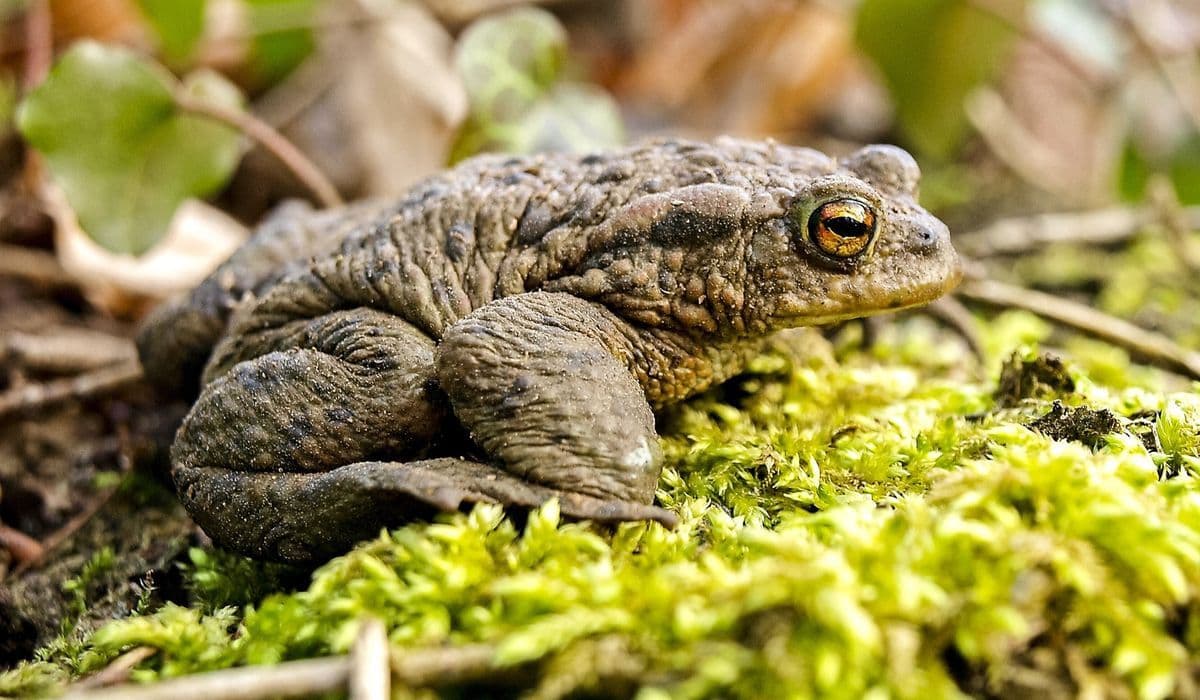
Photo Credit: Toad on moss in the wild.[19]Büscher, Katchy. (2017) Pixabay https://pixabay.com/photos/common-toad-toad-amphibians-nature-2382959/View source
References
- [1]Alanbari, D. H. A., Alkindi, A. P. D. S. K., & Al_Ahbabi, S. H. (2022). Biomimicry design spiral: nature as a model. Journal of Algebraic Statistics, 13(2), 2335-2345
- [2]Arrigo, M. I., De Oliveira Vilaca, L. M., Fofonjka, A., Srikanthan, A. N., Debry, A., & Milinkovitch, M. C. (2019). Phylogenetic mapping of scale nanostructure diversity in snakes. BMC Evolutionary Biology, 19(1), 91. https://doi.org/10.1186/s12862-019-1411-6
- [3]Baeckens, S., Wainwright, D. K., Weaver, J. C., Irschick, D. J., & Losos, J. B. (2019). Ontogenetic scaling patterns of lizard skin surface structure as revealed by gel‐based stereo‐profilometry. Journal of Anatomy, 235(2), 346–356. https://doi.org/10.1111/joa.13003
- [4]Chen, T., Farragher, S., Bjourson, A. J., Orr, D. F., Rao, P., & Shaw, C. (2003). Granular gland transcriptomes in stimulated amphibian skin secretions. Biochemical Journal, 371(1), 125–130. https://doi.org/10.1042/bj20021343
- [5]Das, R., Yadav, R. N., Sihota, P., Uniyal, P., Kumar, N., & Bhushan, B. (2018). Biomechanical evaluation of wasp and honeybee stingers. Scientific Reports, 8(1), 14945. https://doi.org/10.1038/s41598-018-33386-y
- [6]Dong, X., Luo, X., Zhao, H., Qiao, C., Li, J., Yi, J., Yang, L., Oropeza, F. J., Hu, T. S., Xu, Q., & Zeng, H. (2022). Recent advances in biomimetic soft robotics: fabrication approaches, driven strategies and applications. Soft Matter, 18(40), 7699–7734. https://doi.org/10.1039/d2sm01067d
- [7]Du Plessis, A., Broeckhoven, C., Yadroitsev, I., Yadroitsava, I., & Roux, S. G. L. (2018). Analyzing nature’s protective design: The glyptodont body armor. Journal of the Mechanical Behavior of Biomedical Materials/Journal of Mechanical Behavior of Biomedical Materials, 82, 218–223. https://doi.org/10.1016/j.jmbbm.2018.03.037
- [8]Ersanli, E. T., & Ersanli, C. C. (2023). Biomimicry: Journey to the Future with the Power of Nature. International Scientific and Vocational Studies Journal, 7(2), 149–160. https://doi.org/10.47897/bilmes.1388402
- [9]Fung-A-Jou, Z., Bloemberg, J., & Breedveld, P. (2023). Bioinspired medical needles: a review of the scientific literature. Bioinspiration & Biomimetics, 18(4), 041002. https://doi.org/10.1088/1748-3190/acd905
- [10]Hapsari, F. N., Purwaningsih, R., Azzahra, F., & Sari, D. P. (2022). Velcro Product Design with Biomimicry Approaches. IOP Conference Series Earth and Environmental Science, 1111(1), 012057. https://doi.org/10.1088/1755-1315/1111/1/012057
- [11]Hesselberg, T. (2023). The biomimetic potential of novel adaptations in subterranean animals. Frontiers in Ecology and Evolution, 11. https://doi.org/10.3389/fevo.2023.1127728
- [12]Indriani, S., Karnjanapratum, S., Nirmal, N. P., & Nalinanon, S. (2023). Amphibian skin and skin secretion: an exotic source of bioactive peptides and its application. Foods, 12(6), 1282. https://doi.org/10.3390/foods12061282
- [13]Jiang, M., Deng, W., & Lin, H. (2024). Sustainability through Biomimicry: A Comprehensive Review of Bionic Design Applications. Biomimetics, 9(9), 507. https://doi.org/10.3390/biomimetics9090507
- [14]Pathak, S. (2019). Biomimicry: (Innovation inspired by nature). International Journal of New Technology and Research, 5(6). https://doi.org/10.31871/ijntr.5.6.17
- [15]Riiska, C. A., Schuett, G. W., R, M. I. J., & Rieser, J. M. (2025). Preserved reptile scales retain microscopic features, revealing a new instance of convergent evolution. arXiv (Cornell University). https://doi.org/10.48550/arxiv.2505.24827
- [16]Sahlabadi, M., & Hutapea, P. (2018). Tissue deformation and insertion force of Bee-Stinger inspired surgical needles. Journal of Medical Devices, 12(3). https://doi.org/10.1115/1.4040637
- [17]Solga, A., Cerman, Z., Striffler, B. F., Spaeth, M., & Barthlott, W. (n.d.). The dream of staying clean: Lotus and biomimetic surfaces. Bioinspiration & Biomimetics, 2(4), S126–S134. https://doi.org/10.1088/1748-3182/2/4/s02
- [18]Zhao, Z., Zhao, H., Ma, G., Wu, C., Yang, K., & Feng, X. (2015). Structures, properties, and functions of the stings of honey bees and paper wasps: a comparative study. Biology Open, 4(7), 921–928. https://doi.org/10.1242/bio.012195
- [19]Büscher, Katchy. (2017) Pixabay https://pixabay.com/photos/common-toad-toad-amphibians-nature-2382959/
