Feeder Insect Nutrition Facts for Reptile Keepers
Feeder insects contain protein, fat, fiber, and ash. What do these nutrients mean for your reptile? View ReptiFiles' table of feeder insect nutrition stats.
Mariah Healey
Founder, ReptiFiles
Last updated January 9, 2023
(This article contains affiliate links. See why we use affiliate links here.)
How often do you check the nutrition facts on the food you eat? Depending on your fitness and dietary goals, you probably pay attention to carbs, fat, protein, and vitamins. Paying attention to what you eat and pursuing a balanced diet is part of staying healthy as a human. Similarly, paying attention to what you feed your reptiles is key to keeping them healthy.
Both insectivorous and omnivorous reptile species need to eat bugs as part of a balanced diet. But just like fruits and vegetables have different levels of nutrition, so do different kinds of feeder insects. Knowing the nutrient ratios of the insects you give to your reptiles can help you provide more precise nutrition for your reptiles’ individual needs.
Nutrients
The nutrients that you want to pay attention to are Protein, Fat, Fiber, and Ash.
Protein
Protein is essential for building and maintaining muscles, as well as assisting proper organ function and providing energy. High protein insects are great for helping sick or injured reptiles recover, as protein is used for cell maintenance and repair.
It is advised that strict insectivores (reptiles that only eat bugs, no veggies) must be fed a variety of insects to make sure they get the nutrients they need, as some feeders are higher in nutrients than others. Varying gut loads can also help in this respect.
Fat
Fats in insects are generally unsaturated, while birds and mammals (what humans eat) tend to be saturated. However, a high fat diet is still unhealthy for reptiles. The fats may be “healthy” by our considerations, but fat as a nutrient is very high in energy: 9 (kilo)calories per gram of fat, versus 4 (kilo)calories per gram of protein or carbohydrate.
Excess energy gets converted to fat, which can contribute to obesity in pet reptiles. Obesity is common in this setting, as captive reptiles typically get less exercise and more food than in nature. Furthermore, overzealous keepers who like to “spoil” their pets with treats and extra food can also drive them to obesity.
That being said, a no-fat diet isn’t the solution either. It doesn’t work for humans and it doesn’t work with reptiles. Fats are essential for a variety of functions:
- Assists absorption of certain vitamins (vitamins A, D, E, K)
- Cushions internal organs
- Helps create fat stores for brumation and egg laying
- Helps maintain body temperature
The Merck Veterinary Manual recommends that linoleic acid (Omega 6 fatty acid) be included in the diet for overall health. All insects except roaches contain linoleic and linolenic acids, so variety is beneficial.
Fiber (Carbohydrates)
Fiber in insects comes mostly from chitin, or the insect’s exoskeleton. So basically, it’s a complex carbohydrate — the good stuff. The amount of fiber in an insect is typically very low; high amounts can lead to digestive issues if fed too often or in excess. Insectivores are better able to digest high levels of chitin than frugivores/herbivores or even omnivores, as their bodies are built to handle it.
Just in case you get any ideas, the hardness of an insect’s exoskeleton does not indicate higher fiber levels (or chitin content). Instead, it’s due to certain protein chains used to reinforce the exoskeleton.
Ash
What the heck is ash? It’s the leftovers — the parts of the bug that aren’t protein, fat, or fiber. This is typically composed of salts, minerals, and metals, including the insect’s gut contents. Higher levels of ash, then, can be assumed to correlate with higher levels of vitamins/minerals as well as a larger gut capacity.
Ca:P — The Calcium to Phosphorus Ratio
You’ve probably seen this mentioned in the context of supplements — if you’ve read my article, What You Need to Know About Reptile Vitamins, it’s probably especially familiar. That’s because like UVB and vitamin D3, knowing how to balance your reptile’s dietary calcium and phosphorus intake is critical to managing its health.
Reptiles require twice as much dietary calcium as they do phosphorus. This is because in order to properly metabolize (or digest) phosphorus, calcium must be present. In other words, they require a dietary calcium to phosphorus ratio of approximately 2:1. When there isn’t enough calcium for the reptile’s body to properly process phosphorus, it will steal calcium from bones and other stores. Over time, this repeated robbery of calcium can lead to MBD.
Most insects contain more phosphorus than they do calcium, which is why we dust (a common exception is black soldier fly larvae, and we’ll get to that in a bit). Calcium supplements are designed to correct the natural imbalance between calcium and phosphorus. When choosing a calcium powder, make sure that it does not contain phosphorus or more than 5000 IU/kg of vitamin D3.
- Arcadia
- Miner-ALL
- Repashy Supercal
If you have a calcium deficient reptile, Repashy RescueCal+ is a good choice to help them recover.
“Dry Matter” vs “As Fed”
Most insect nutrition is measured in “Dry Matter,” or nutrition of an insect based on its nutritional value when dried out. Moisture content (“As Fed”) can distort individual nutrition percentages. However, when comparing nutrient value between feeder insects, the opposite holds true: As Fed is more accurate.
Fortunately, if you know the moisture percentage of a feeder, you can convert from As Fed to Dry Matter basis and vice versa with a little basic math.
Converting from As Fed to Dry Matter: Divide the percentage of desired nutrient As Fed by the percentage Dry Matter. The result is the percentage of that nutrient by dry weight.
Converting from Dry Matter to As Fed: Multiply the percentage of desired nutrient on a Dry Matter basis by the percentage of total Dry Matter. The result is the percentage of that nutrient As Fed.
Why should you care? Knowing these percentages gives you the knowledge to make educated decisions about which feeders to give your reptiles, and how often, based on individual needs.
ReptiFiles’ Chart of Feeder Insect Nutrition Facts
By this point you’re probably wondering how accurate this information can be. Of course, the specific nutritional value of any given feeder insect will vary depending on the quality of its gutload and the breeder’s insect husbandry. This data assumes that each feeder is properly gutloaded and healthy, and has been averaged from the sources of nutritional information that I’ve found for each type.
The following data is presented “As Fed,” and has been rounded to the nearest percent for simplicity’s sake.
nd = No data
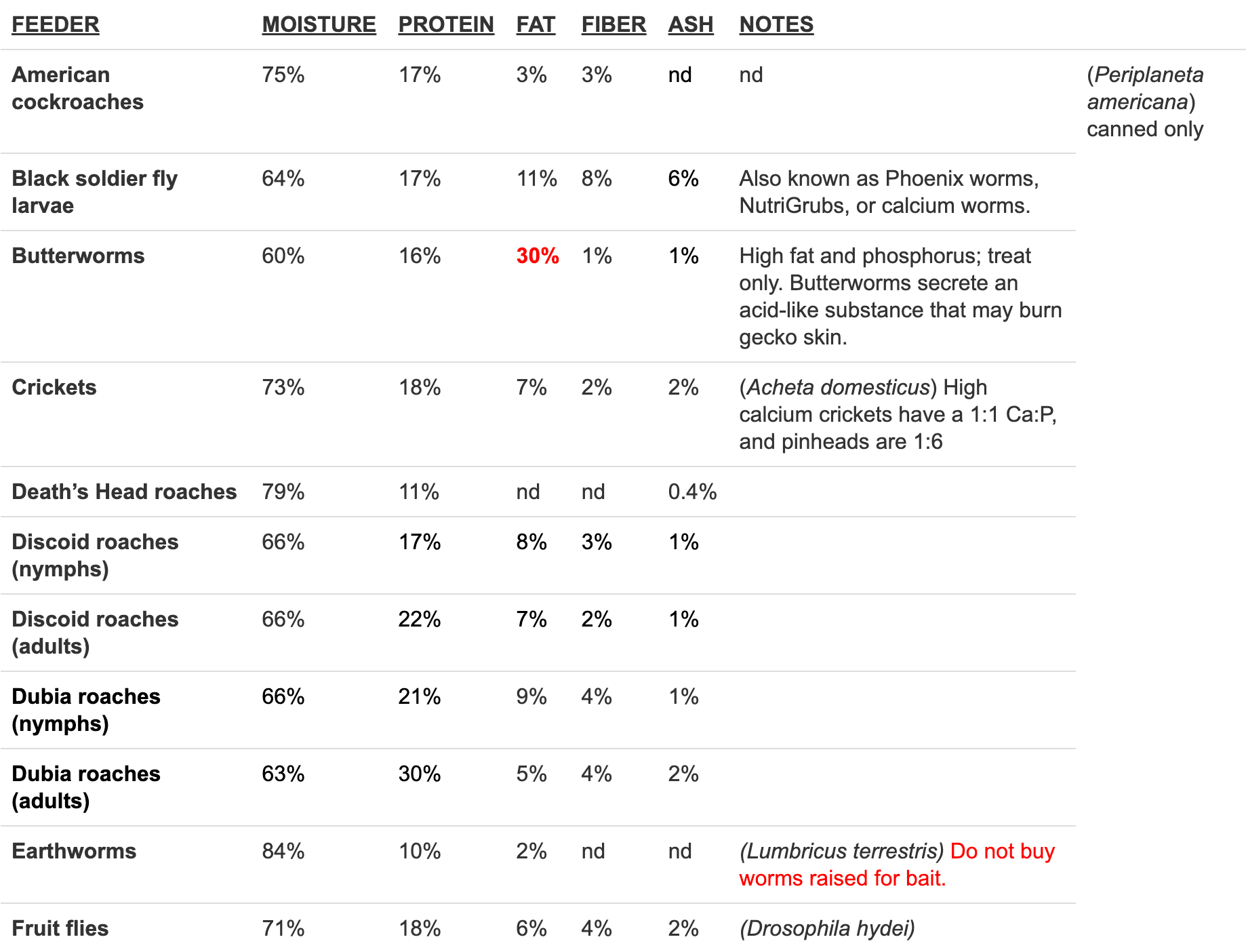
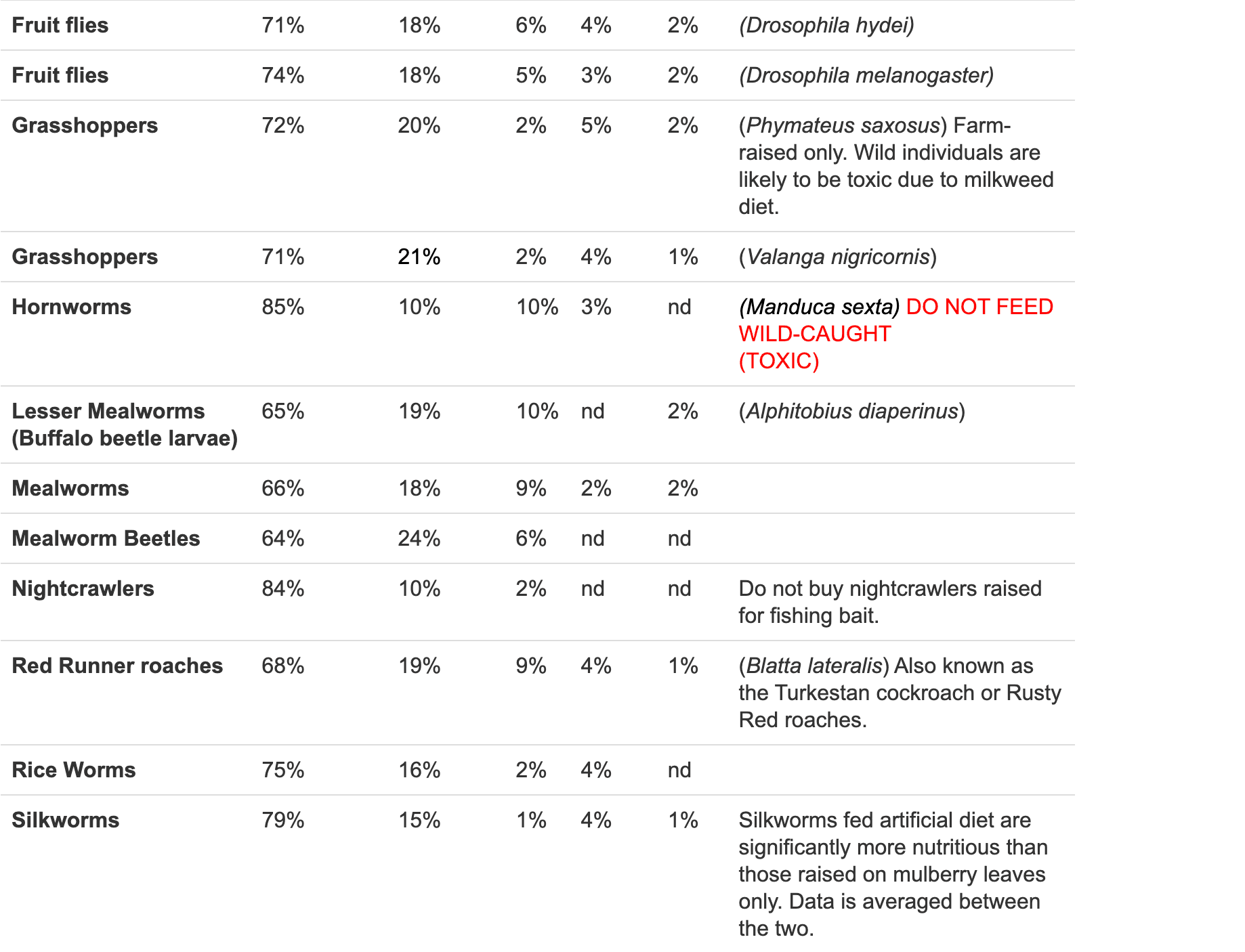
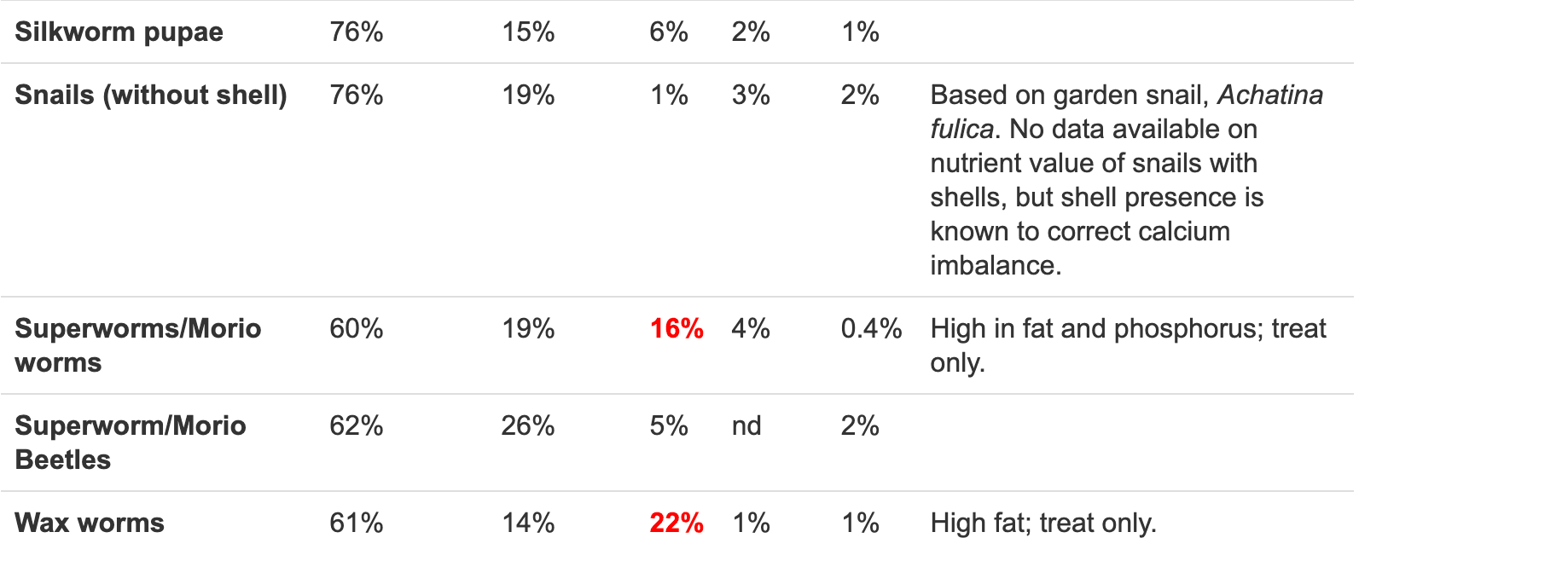
Note: There is a rising number of reports of cases of gout occurring in bearded dragons and leopard geckos that are primarily fed on dubia roaches for the protein portion of their diet. This is correlation, and has not yet been proven as causational. There is no reason to entirely rule out dubia roaches as a feeder insect. Using a variety of feeders (at least 3 different species) is an important part of any insectivore diet, but in light of the current data, ReptiFiles strongly advises owners of insectivorous reptiles to make extra efforts to vary their pet’s feeders as much as possible, particularly if adult dubias are part of the diet. (Edit date: 12/10/2021)
How to Create More Variety in Your Reptile’s Diet
As mentioned previously, variety is the key to optimum health in a reptile’s diet. You don’t think that wild reptiles only eat one or two types of foods, do you? If they were that picky, they would have died out due to starvation long ago. This variety in their diet provides a wild spectrum of nutrients and creates a foundation for optimal health.
Of course, offering a variety of insects is more difficult for a pet reptile than it is for a wild reptile. There’s a huge variety of bugs ready-to-eat in the wild. For captivity, they need to be intentionally raised or purchased one by one. Here are some methods that I’ve personally found effective for increasing variety in my insectivorous and omnivorous reptiles’ diets:
Buy your bugs online. It’s more convenient to buy feeder insects from your local pet store, but pet stores often have a very limited supply of available feeders — if you’re lucky, you might have access to crickets, mealworms, dubia roaches, hornworms, superworms, and waxworms. But if you head online, you’ll be able to find a wider variety of feeders to try with your reptile. Here are some of my favorite outlets for purchasing feeder insects:
Try canned insects. They may seem gross, and they definitely don’t smell like roses. But canned bugs are available at most pet stores, and are tasty enough to be readily accepted by most reptiles. What I like best about them is that they give me access to certain types of feeders that are hard to find anywhere else, such as snails (shell-less, unfortunately) and grasshoppers. Zoo Med is my go-to for canned bugs, but Exo Terra, ProBugs, and Dubia.comare also good.
Go foraging. Collecting wild insects is a faux pas in many Facebook reptile groups, but the fact of the matter is that it’s only dangerous if you accidentally collect something poisonous or collect them from a polluted area. This can be easily prevented by only collecting from areas untainted by pesticides, herbicides, or vehicle exhaust, and identifying the bugs you’ve collected before feeding them to your reptile. If you’re concerned about parasite contamination, make sure to get your pet checked for parasites regularly and treat accordingly (which you should already be doing anyway).
References
Barrow-Agee Laboratories, LLC. (2016). Certificate of Analysis. Sample Identification: Extra Small Dubia. (Report No. 022516-05). Dubia.com. https://dubiaroaches.com/blogs/feeder-insects/dubia-roaches-vs-common-feeder-insects
Barrow-Agee Laboratories, LLC. (2016). Certificate of Analysis. Sample Identification: Medium Dubia. (Report No. 022516-06). Dubia.com. https://dubiaroaches.com/blogs/feeder-insects/dubia-roaches-vs-common-feeder-insects
Barrow-Agee Laboratories, LLC. (2016). Certificate of Analysis. Sample Identification: Extra Large Dubia. (Report No. 022516-07). Dubia.com. https://dubiaroaches.com/blogs/feeder-insects/dubia-roaches-vs-common-feeder-insects
Bjørge, J. D., Overgaard, J., Malte, H., Gianotten, N., & Heckmann, L.-H. (2018). Role of temperature on growth and metabolic rate in the tenebrionid beetles Alphitobius diaperinus and Tenebrio molitor. Journal of Insect Physiology, 89–96. https://doi.org/10.1016/j.jinsphys.2018.02.010
Black Soldier Fly Larvae Care Sheet. (n.d.). Fluker’s Cricket Farms. https://flukerfarms.com/black-soldier-fly-larvae-care-sheet/
Can O’ Cockroaches. (n.d.). Zoo Med Laboratories. Retrieved from https://zoomed.com/can-o-cockroaches/ Cerreta, A. J., Smith, D. C., Ange‐Van Heugten, K., & Minter, L. J. (2021). Comparative nutrient analysis of four species of cockroaches used as food for insectivores by life stage, species, and sex. Zoo Biology, 1, 26–33. https://doi.org/10.1002/zoo.21647 Crickets. (n.d.). Timberline. Retrieved from https://timberlinefresh.com/learn/insects/crickets/
Critterdepot. (n.d.). Dubia Roaches vs. Discoid Roaches – What’s the Difference? Retrieved from https://critterfam.com/forums/topic/difference-between-dubia-roaches-and-discoid-roaches
Desertcart. (n.d.). Exo Terra Medium Silkworms, 1.2 Ounces. Retrieved from https://aruba.desertcart.com/products/10450284-exo-terra-medium-silkworms-1-2-ounces
Exo Terra. (n.d.). Exo Terra Reptiles Canned Food, Mealworms, 1.2-Ounce. Retrieved from https://www.amazon.com/Exo-Terra-Reptiles-Mealworms-1-2-Ounce/dp/B000CMKHCC/
Exo Terra. (n.d.). Exo Terra Reptiles Canned Food, Grasshoppers, 1.2-Ounce. Retrieved from https://www.amazon.com/Exo-Terra-Reptiles-Grasshoppers-1-2-Ounce/dp/B000CMKHBS/
Exo Terra. (n.d.). Exo Terra Reptiles Canned Food, Grasshoppers, 1.2-Ounce. Retrieved from https://www.amazon.in/Exo-Terra-Reptiles-Grasshoppers-1-2-Ounce/dp/B000CMKHC2
Exo Terra. (n.d.). Exo Terra Reptiles Canned Food, Small Crickets, 1.2-Ounce. Retrieved from https://www.amazon.com/Exo-Terra-Reptiles-Crickets-1-2-Ounce/dp/B000CMFVKK
Exo Terra. (n.d.). Exo Terra Reptiles Canned Food, Unshelled Snails, 1.7-Ounce. Retrieved from https://www.amazon.com/Exo-Terra-Reptiles-Unshelled-1-7-Ounce/dp/B000CMFVKA/
Finke, M. D. (2015). Complete nutrient content of four species of commercially available feeder insects fed enhanced diets during growth. Zoo Biology, 6, 554–564. https://doi.org/10.1002/zoo.21246
Great Lakes Hornworm. (n.d.). Great Lakes Hornworm. Retrieved January 9, 2023, from https://greatlakeshornworm.com/
Hornworms. (n.d.). Timberline. Retrieved January 9, 2023, from https://timberlinefresh.com/products/hornworms/
Kulma, M., Kouřimská, L., Homolková, D., Božik, M., Plachý, V., & Vrabec, V. (2020). Effect of developmental stage on the nutritional value of edible insects. A case study with Blaberus craniifer and Zophobas morio. Journal of Food Composition and Analysis, 103570. https://doi.org/10.1016/j.jfca.2020.103570
Kulma, M., Plachý, V., Kouřimská, L., Vrabec, V., Bubová, T., Adámková, A., & Hučko, B. (2016, December 16). Nutritional value of three Blattodea species used as feed for animals. Retrieved from http://www.jafs.com.pl/Nutritional-value-of-three-Blattodea-species-used-as-feed-for-animals,67916,0,2.html
Kolesnyk, N., Simon, M., Marenkov, O., & Nesterenko, O. (2020). Cultivation of dipterous (Diptera Linnaeus, 1758) insects, such as fruit flies, synanthropic flies larvae and chironomids larvae for fish feeding (review). Ribogospodarsʹka Nauka Ukraïni., 1(51), 53–78. https://doi.org/10.15407/fsu2020.01.053
Kurečka, M., Kulma, M., Petříčková, D. et al. Larvae and pupae of Alphitobius diaperinus as promising protein alternatives. Eur Food Res Technol 247, 2527–2532 (2021). https://doi.org/10.1007/s00217-021-03807-w
Lamberti, C., Gai, F., Cirrincione, S., Giribaldi, M., Purrotti, M., Manfredi, M., … Cavallarin, L. (2019, June 12). Investigation of the protein profile of silkworm (Bombyx mori) pupae reared on a well-calibrated artificial diet compared to mulberry leaf diet. Retrieved from https://www.ncbi.nlm.nih.gov/pubmed/31223520
Nairn, T. (n.d.). Bearded Dragon Diet and Nutrition [Over 125 Safe Food List]. Retrieved from https://beardeddragonsworld.com/bearded-dragon-diet
Oonincx, D. G. A. B., & Dierenfeld, E. S. (2011). An Investigation Into the Chemical Composition of Alternative Invertebrate Prey. Zoo Biology, 1, 40–54. https://doi.org/10.1002/zoo.20382
Park, Haeree H., “Black Soldier Fly Larvae Manual” (2016). Student Showcase. 14.
Retrieved from https://scholarworks.umass.edu/sustainableumass_studentshowcase/14
ProBugs USA. (n.d.). ProBugs USA. Retrieved from https://probugsusa.com/
Zoo Med Laboratories. (n.d.). Zoo Med Laboratories. Retrieved from https://zoomed.com/